

T20 World Cup: 5 Big Concerns for India Before Super 8

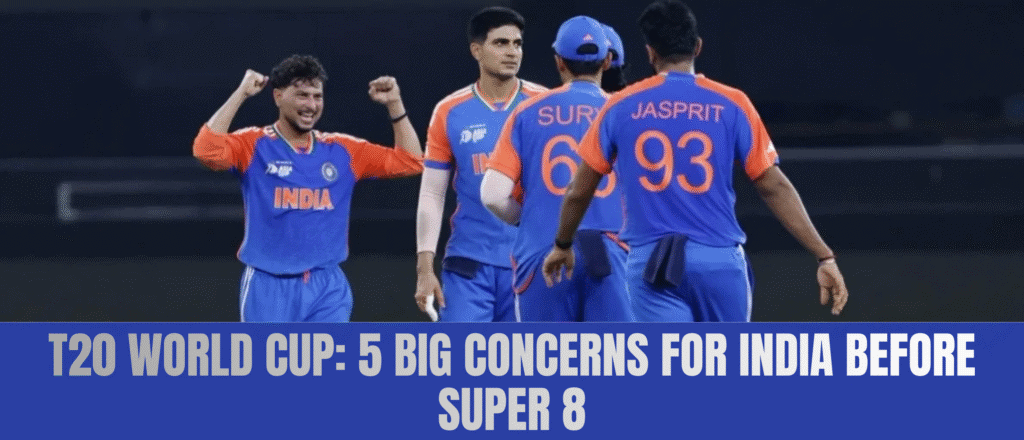
T20 World Cup preparations have entered a critical phase for India, with 5 big concerns emerging ahead of the Super 8 stage despite an unbeaten group run. India assistant coach Ryan ten Doeschate openly addressed key tactical issues after the win over the Netherlands, admitting that improvements are necessary if India are to dominate the T20 World Cup knockout rounds.
While India secured four wins in four matches in the T20 World Cup group stage, the coaching staff believes the team has not yet played a complete game. The challenges of handling finger spin and managing a left-heavy top order could shape India’s ICC campaign moving forward.
India’s T20 World Cup Dominance Masks Tactical Flaws
India’s perfect record in the T20 WC group stage reflects consistency, but underlying patterns suggest areas of concern. Ryan ten Doeschate acknowledged that the top-order composition — featuring multiple left-handers has made it easier for opponents to plan strategically in ICC contests.
With Abhishek Sharma, Ishan Kishan, and Tilak Varma forming a predominantly left-handed trio, rival teams have introduced off-spinners during the powerplay in T20 WC matches. This tactical adjustment has disrupted India’s rhythm early in innings.
Despite the victories, the T20 WC data indicates that India’s top order has struggled to counter sustained finger spin pressure, especially in slower conditions.
Finger Spin Challenge in T20 World Cup Matches
The most pressing issue highlighted by the India coach revolves around struggles against finger spin. In the recent T20 WC clash, Netherlands off-spinner Aryan Dutt bowled crucial overs in the powerplay and dismissed key batters, reinforcing the effectiveness of this strategy in ICC tournaments.
Doeschate clarified that the concern is not limited to traditional off-spin but includes all forms of finger spin. Pakistan previously deployed multiple overs of finger spin to apply pressure, and upcoming T20 World Cup opponents are expected to follow similar tactics.
In the Super 8 stage of the ICC event, India will face teams equipped with quality finger spinners, making tactical adaptability essential. The coach emphasized that batters must develop clearer game plans to counter this recurring threat.
Left-Handed Top Order and Tactical Predictability
The abundance of left-handers at the top has added predictability to India’s T20 WC approach. While the management maintains confidence in its best available batters, the opposition has increasingly exploited matchups in ICC contests.
Deploying spin early restricts scoring options and limits boundary opportunities. On larger grounds like Ahmedabad and slower wickets such as Colombo, this tactic has magnified India’s T20 World Cup challenges.
Although Sanju Samson remains an option, the team balance currently favors continuity. However, adaptability will be crucial as the ICC Super 8 fixtures demand strategic flexibility.
Conditions Amplifying T20 World Cup Pressure
Venue conditions have also influenced India’s T20 World Cup performances. Slower surfaces and expansive boundaries have made it difficult to accelerate against spin. According to the coaching staff, better batting surfaces may ease these struggles, but preparation for challenging conditions remains vital in ICC competitions.
The Netherlands, having analyzed India’s previous T20 World Cup match against Pakistan, attempted to choke scoring in the powerplay with spin. This tactical blueprint underscores how closely teams are studying India’s ICC strategy.
In high-stakes T20 World Cup matches, even minor tactical weaknesses can become decisive factors in knockout scenarios.
Abhishek Sharma’s Form Not a Long-Term Concern
Despite multiple low scores, the India coach expressed confidence in Abhishek Sharma’s ability to recover during the T20 World Cup Super 8 stage. Sharma’s preparation was disrupted by illness earlier in the ICC tournament, affecting his continuity and rhythm.
Doeschate revealed that the left-hander showed promising signs in practice sessions before the Netherlands match. The management remains optimistic that Sharma will regain confidence and contribute meaningfully in upcoming T20 World Cup fixtures.
Backing key players during lean phases is a hallmark of successful ICC campaigns, and India appear committed to supporting their young talent.
Super 8 Fixtures to Test India’s ICC Credentials
The T20 World Cup Super 8 stage presents sterner examinations for India. Facing quality teams such as South Africa and other strong opponents will demand improved execution against spin and greater tactical awareness.
India’s batting unit must devise clearer strategies when wickets slow down and bowlers exploit variations. Strike rotation, controlled aggression, and calculated risk-taking will be central to navigating the ICC challenge.
The coaching staff has acknowledged that perfection remains elusive despite the unbeaten run. Addressing these weaknesses before knockout rounds could determine India’s ultimate T20 World Cup success.
Can India Overcome T20 World Cup Spin Threat?
As the T20 World Cup intensifies, India’s adaptability will be under scrutiny. The ability to counter finger spin effectively, reduce predictability in the top order, and adjust to diverse conditions will define their ICC campaign.
India remain strong contenders in the T20 World Cup, but the margin for error narrows in the Super 8 stage. If batters respond positively to tactical challenges and execute well-defined game plans, India can sustain their winning momentum in the ICC tournament.
The coming fixtures will reveal whether these identified concerns become stumbling blocks or stepping stones. For now, India enter the Super 8 phase of the T20 World Cup unbeaten yet aware that refinement is essential to transform promise into championship success.
Responses