

T20 World Cup 2026: 5 Big Questions Over India’s Shock Setback

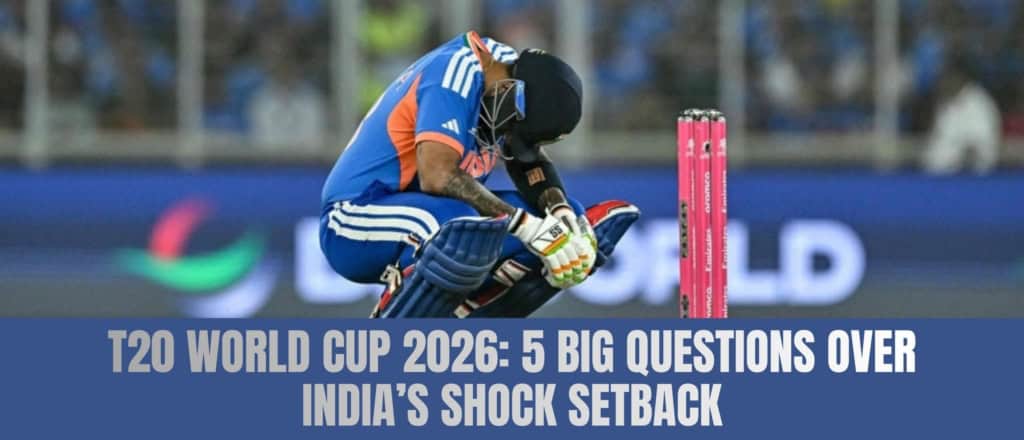
T20 World Cup 2026 has thrown India into an unexpected crisis, with serious questions being raised about preparation, team selection, and leadership decisions after their defeat to South Africa. The loss in the Super 8 stage has left India in a must-win situation, and critics believe the setback reflects deeper issues within the squad. As the T20 WC 2026 intensifies, scrutiny on India’s campaign is growing louder.
The defeat has not only complicated India’s semi-final chances in the T20 WC 2026 but also sparked debate about tactical choices, particularly the decision to drop vice-captain Axar Patel. Former cricketer Mohammad Kaif has openly questioned the team’s preparation, drawing comparisons with past championship-winning sides.
T20 World Cup 2026: India’s Preparation Under Scanner
The T20 WC 2026 was expected to be another dominant chapter for India, especially after their previous global success. However, the loss to South Africa in the Super 8 stage has exposed vulnerabilities. According to Mohammad Kaif, India’s preparation appears inconsistent, particularly in handling match-ups and team balance.
Kaif argued that great captains like MS Dhoni and Rohit Sharma focused on building a settled playing XI that could adapt to any situation. In contrast, the sudden decision-making seen in the T20 World Cup 2026 suggests uncertainty. The choice to exclude Axar Patel raised eyebrows and fueled criticism about tactical planning.
Axar Patel’s Exclusion in T20 World Cup 2026
Axar Patel’s omission from the Super 8 clash against South Africa became the focal point of post-match analysis in the T20 WC 2026. Axar has been a proven performer in high-pressure ICC events, contributing both with bat and ball.
Kaif questioned why a player who played crucial roles in the previous T20 World Cup triumph was sidelined. Axar had delivered impactful performances in knockout matches, including dismissing key left-handers in past tournaments. Dropping him in the T20 World Cup 2026, critics argue, sent the wrong message about stability and trust within the squad.
The Debate Around Team Combinations
Team combinations have become a central theme in India’s T20 WC 2026 campaign. Kaif emphasized that championship teams typically avoid last-minute changes unless forced by injury. The sudden reshuffle, he suggested, indicated panic rather than strategy.
The decision to tweak the XI based on perceived opposition match-ups did not deliver the desired results in the T20 WC 2026. South Africa capitalized on India’s unsettled structure and secured a commanding victory.
Comparisons With Dhoni and Rohit Era
In evaluating India’s performance in the T20 World Cup 2026, Kaif referenced the leadership approach of MS Dhoni and Rohit Sharma. Both captains were known for backing players through challenging phases, creating confidence and clarity within the squad.
The stability of earlier title-winning teams stood in contrast to the current uncertainty seen in the T20 World Cup 2026. Kaif highlighted how previous squads maintained faith in their spin options and balanced their line-ups without overreacting to opposition strengths.
Pressure Mounts Ahead of Must-Win Matches
India now face a must-win scenario in the T20 World Cup 2026. With West Indies posting a massive win against Zimbabwe and South Africa maintaining momentum, India’s margin for error has disappeared. Every upcoming match in the T20 World Cup 2026 carries knockout-level pressure.
The team must secure victories in their remaining Super 8 games and hope other results align favorably. Net run rate could also become a decisive factor in determining qualification. This combination of pressure and uncertainty has amplified the debate about preparation and planning in the T20 World Cup 2026.
Was There Panic in India’s Strategy?
One of the strongest criticisms emerging from the T20 World Cup 2026 setback is the perception of panic. Kaif pointed out that South Africa appeared composed despite earlier setbacks, while India made sudden changes.
The decision-making process during the Super 8 clash has fueled the narrative that India reacted to pressure rather than executing a pre-defined plan in the T20 World Cup 2026. Maintaining composure in crucial matches is often the difference between contenders and champions.
Importance of Backing Proven Match-Winners
The T20 World Cup 2026 demands players who can deliver in crunch moments. Axar Patel’s previous contributions in ICC tournaments have established him as a reliable match-winner. Critics argue that backing such players builds confidence and continuity.
Kaif noted that Axar’s performance in earlier finals and semi-finals showcased his ability to handle high-pressure situations. By sidelining him in a critical T20 World Cup 2026 match, India may have disrupted team equilibrium.
India’s Road Ahead in T20 World Cup 2026
Looking forward, India must regroup quickly in the T20 World Cup 2026. The focus now shifts to tactical clarity, stable combinations, and restoring confidence. The remaining fixtures will determine whether India’s campaign ends in disappointment or dramatic resurgence.
The T20 World Cup 2026 has already delivered surprises, and India’s fate remains uncertain. A strong comeback could silence critics and validate management decisions. However, another misstep would confirm concerns about preparation and strategy.
As the tournament progresses, the spotlight remains firmly on India. The T20 World Cup 2026 is unforgiving, and only teams with clarity, composure, and cohesion will advance. For India, the next match may define not just qualification but the overall assessment of their campaign.


Responses