

Matildas Secure Ninth Consecutive Women’s World Cup Spot with Victory Over Korea DPR

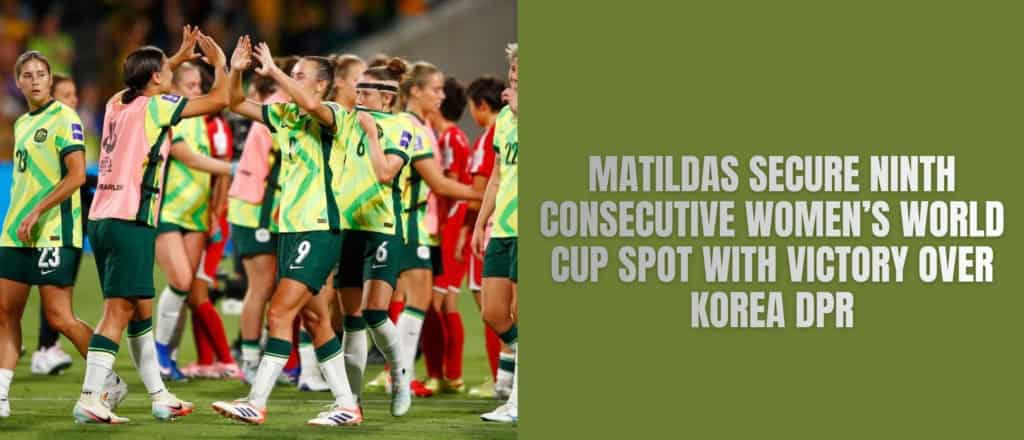
The Matildas have stamped their ticket to the FIFA Women’s World Cup for the ninth consecutive edition after a tense 2-1 victory over Korea DPR in Perth during the AFC Women’s Asian Cup 2026. Goals from veteran defender Alanna Kennedy and star striker Sam Kerr secured the win, while the team weathered sustained pressure from the North Korean side to maintain their flawless World Cup qualification record dating back to Sweden 1995.
Ninety-four hundred days after heartbreak in the 2023 Women’s World Cup semi-final on home soil, the Matildas found themselves under significant scrutiny. Head coach Joe Montemurro’s side faced key injury absences in Steph Catley and Hayley Raso, and the match came with expectations from a passionate home crowd. Korea DPR arrived as a technically adept and highly organized side, posing a serious threat throughout the game with fluid passing and coordinated attacks.
Early Impact from Alanna Kennedy
The opening goal set the tone just nine minutes into the quarter-final. Alanna Kennedy, deployed as a defensive midfielder in Montemurro’s 4-3-3 formation, latched onto a cutback from Sam Kerr, with a slight deflection from Chae Un-yong, before striking cleanly from the edge of the penalty area. Kennedy’s goal not only gave the Matildas an early lead but also provided crucial composure for a team balancing nerves and a strong opposition onslaught.
The initial advantage allowed Australia to settle temporarily, yet Korea DPR dominated the remaining first half. Chae Un-yong, Kim Kyong-yong, and Hong Song-ok created multiple scoring opportunities, forcing the Matildas to maintain defensive discipline and rely on goalkeeper Mackenzie Arnold for critical saves. Despite Korea DPR’s control in possession and territory, Australia managed to preserve the slender lead into halftime.
Sam Kerr’s Early Second-Half Strike
Australia doubled their lead just two minutes after the restart when Sam Kerr produced a moment of individual brilliance. Capitalizing on pressure applied by midfielder Katrina Gorry, Kerr took one touch to control the ball before striking past Yu Son-gum. Returning to her hometown, Kerr’s goal energized the Matildas and briefly relieved the mounting pressure from a relentless Korean attack.
From this point, the match intensified as Korea DPR pressed aggressively, testing Australia’s defensive resilience. The North Koreans’ fluid movements and overlapping runs created numerous chances, but the Matildas’ defensive organization and Arnold’s goalkeeping ensured that the lead remained intact for a significant period.
Korea DPR’s Response and Maintaining Composure
Persistence eventually paid off for Korea DPR in the 65th minute when Chae Un-yong converted a precise cross from Kim Kyong-yong. This goal reignited tension in the stadium and forced the Matildas to defend with renewed urgency. In the final quarter, Korea DPR dominated possession and orchestrated multiple threatening sequences, yet their finishing proved inconsistent. Wayward attempts and timely interventions from the Matildas’ defense kept the scoreline in Australia’s favor.
The team’s ability to absorb pressure, maintain shape, and respond tactically highlighted the experience and leadership within the squad. Montemurro’s tactical adjustments, including compact positioning and coordinated pressing in midfield, ensured that Australia could withstand repeated attacks while protecting key scoring threats like Kerr and Kennedy for counter-attacks.
Significance of the Qualification
This victory marks a historic achievement for the Matildas, as they become the first non-host nation to secure qualification for the next Women’s World Cup. The result also reinforces their status as a consistent powerhouse in women’s football, having appeared in every edition of the tournament since its inception in 1995. With the AFC Women’s Asian Cup doubling as the World Cup qualifying tournament, Australia demonstrated both technical proficiency and mental resilience, proving capable of performing under intense scrutiny and high-stakes conditions.
Thoughts On The Future
While Australia celebrates qualification, the road to the FIFA Women’s World Cup 2027 will demand continued consistency and squad management. With injuries already affecting key players, Montemurro faces the task of maintaining depth and rotation while preparing tactical plans against world-class opponents. The Matildas’ blend of experienced internationals like Kennedy and Kerr, combined with emerging talent, positions them well for competitive campaigns both in Asia and on the global stage.
The quarter-final performance also underscores areas for development. Australia must refine defensive transitions, improve possession retention under pressure, and ensure finishing efficiency in tight matches. The Matildas’ capacity to handle high-pressure games will be tested further in upcoming international fixtures, offering opportunities to consolidate confidence before the World Cup.
By overcoming Korea DPR, the Matildas reaffirm their status as a leading Asian football nation. Their consistent qualification streak, key contributions from star players, and ability to manage adverse conditions reflect a program with both resilience and ambition. Fans can look forward to another high-profile campaign at the global showpiece, with Australia aiming to surpass previous bests and contend for top honors on the world stage.
Written by 8jjsports.com | March 15, 2026
Stay updated with 8jj Sports for Live Sports Scores, News & Community





Responses