

Thomas Tuchel Redefines England Squad Strategy Ahead of Exciting World Cup 2026

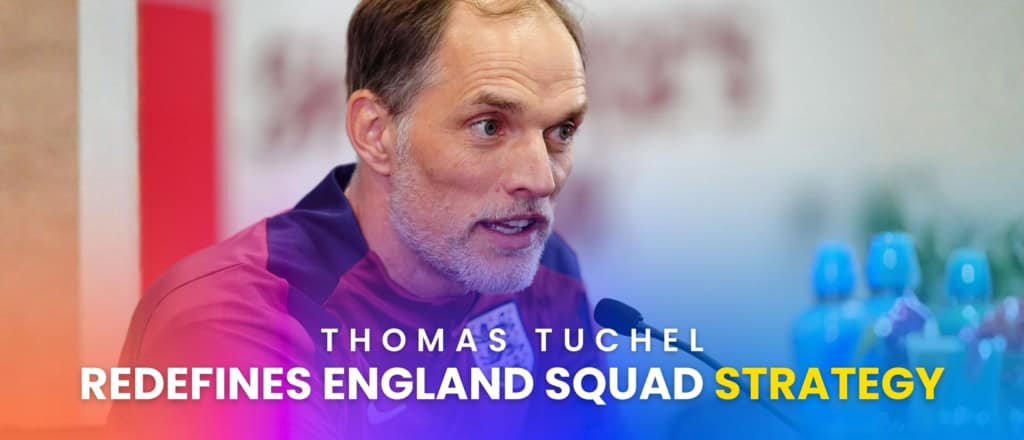
Structural pressure forces a rethink of international preparation logic
Thomas Tuchel’s final phase of preparation for the World Cup is unfolding under conditions that no longer resemble traditional international football cycles. England’s qualification campaign was completed with perfect efficiency, but that success has only intensified the next problem: how to prepare a squad that no longer exists in a stable physical or tactical state between club and country obligations.
The modern international manager is no longer operating in an environment of controlled readiness. Instead, squads arrive fragmented, physically taxed, and tactically overloaded from vastly different club systems. For Thomas Tuchel, this reality has become the central constraint shaping England’s March international window.
Rather than attempting to force uniformity across a heavily fatigued group, Thomas Tuchel has instead shifted toward structural segmentation. The decision to name a 35 player squad is not expansion for experimentation alone. It is an attempt to rebuild control inside a system that has become structurally uncontrollable.
In essence, England are no longer being prepared as a single unit. They are being prepared as overlapping performance states.
This shift marks a significant departure from previous England cycles, where consistency and repetition were prioritised over situational adaptation. Tuchel’s approach acknowledges that those principles no longer align with modern elite football demands, particularly at a stage of the season where club competitions are at their most intense and physically draining.
The result is a controlled disruption of the traditional international camp model.
The 35 player framework as a managed selection ecosystem
At the centre of Thomas Tuchel’s approach is a deliberately engineered squad structure that divides England’s preparation into two functional environments. The 35 player group is not intended to operate as a single training cohort. Instead, it is segmented into distinct competitive layers, each serving a specific analytical and tactical purpose.
The Uruguay fixture acts as the first operational layer. It is designed as an evaluation-heavy environment where fringe players and emerging internationals are assessed under realistic match conditions. These players are not being judged solely on technical quality, but on adaptability within compressed preparation cycles, decision-making speed under limited tactical rehearsal, and their ability to execute within a partially rotated structure.
The Japan fixture represents the second layer of the system. Here, Thomas Tuchel reintroduces England’s core group, focusing on structural stability rather than experimentation. The purpose is not to test players but to reinforce tactical coherence among those most likely to define England’s World Cup identity.
This dual-layer design transforms the international window into a controlled simulation environment. One phase is exploratory, the other is consolidative. Together, they replace what would traditionally be a single blended preparation camp.
Fragmentation of modern player availability reshapes managerial control
A critical driver behind Thomas Tuchel’s structural adjustment is the fragmentation of player availability caused by modern club football intensity. Players are no longer arriving at international duty in consistent condition. Instead, they come from vastly different physical and tactical states depending on their club responsibilities.
Thomas Tuchel’s response is to stop attempting to neutralise that imbalance and instead design around it.
By separating squad functions across two matches, he reduces the requirement for immediate homogenisation. Players are no longer forced into a single tactical system at full intensity from day one. Instead, their integration is staggered based on role relevance and physical readiness.
This also changes the internal competition dynamic. Rather than competing simultaneously in every training session, players are effectively evaluated within context-specific environments. A fringe attacker is assessed in a high-variation match setting against Uruguay, while a senior forward operates in a more structured system against Japan.
Tactical selection becomes conditional rather than fixed
One of the most significant consequences of Thomas Tuchel’s system is that England’s tactical selection process is no longer fixed around a single preferred starting XI. Instead, selection is now conditional, depending on match phase, opposition profile, and squad load distribution.
Players are not being locked into fixed hierarchies. They are being evaluated within multiple functional contexts.
This is particularly relevant in attacking and midfield zones, where England’s depth has created overlapping skill profiles. Thomas Tuchel’s system allows these distinctions to be assessed independently rather than merged into a single evaluation framework.
Early indication of long-term World Cup selection filtering
The 35 player squad also functions as an early filtering mechanism for final World Cup selection. With limited time before tournament preparation intensifies, every match now carries disproportionate weight in evaluation.
Certain players are already trending toward inclusion based on adaptability and reliability under structured systems, while others are being assessed for consistency in role execution.
This compresses decision-making timelines and increases the importance of match-based evaluation over training observation alone.
Control replaces continuity in Tuchel’s England model
The defining principle of Thomas Tuchel’s current England approach is control under constraint.
By splitting the squad into two operational environments, he is reconstructing how international football preparation functions at elite level. England are no longer being prepared as a single tactical organism but as a managed system of conditional roles shifting between evaluation and execution depending on context.
This is the foundation on which the rest of England’s World Cup preparation will be built.
Training load redistribution becomes the hidden core of squad management
If Section 1 defined Thomas Tuchel’s structural response to international scheduling pressure, then Section 2 is where the operational reality of that decision begins to take shape. The 35 player framework is not just a selection mechanism, it is a training architecture that fundamentally changes how England prepare between matches.
At elite international level, training time is no longer abundant enough to rebuild tactical identity from scratch. It is instead used to refine, reinforce, and selectively adjust systems that are already partially formed at club level. Thomas Tuchel understands this limitation more clearly than most managers operating in the international game, and his approach reflects a shift away from traditional full-group tactical rehearsals.
Instead of attempting to impose a single unified training load across 35 players, England’s camp is effectively divided into micro-environments. Each environment receives a different training intensity, tactical focus, and recovery schedule depending on its role in the upcoming fixture cycle.
This redistribution of training load is not a convenience measure. It is a structural necessity created by the density of the modern club calendar. Players arriving from Champions League knockout matches or Premier League title races cannot be processed through uniform training sessions without risking either injury or cognitive overload.
Thomas Tuchel’s solution is to segment training reality itself.
Tactical language split between experimental and stabilised groups
One of the most underappreciated aspects of Tuchel’s model is the creation of two separate tactical languages within a single international camp. The Uruguay group and the Japan group are not just different in personnel, they are different in how tactical instructions are delivered, absorbed, and executed.
The Uruguay-facing group operates in a high-variability tactical environment. Instructions are shorter, more adaptive, and designed to be executed under uncertainty. This reflects the reality of fringe players who may not have long-term tactical embedding within England’s system but are being evaluated on their capacity to interpret instructions quickly.
In contrast, the Japan group operates within a stabilised tactical framework. Here, Tuchel can reintroduce more detailed structural principles, particularly in build-up patterns, pressing triggers, and defensive spacing. Because this group contains England’s core players, there is a higher expectation of tactical recall and positional consistency.
This separation allows England to function simultaneously in two tactical states. One is reactive and evaluative, the other is structured and reinforcing.
The significance of this cannot be overstated. It allows Tuchel to avoid the most common failure of international camps, which is tactical dilution caused by excessive compromise between player groups with vastly different preparation needs.
Position-specific management replaces traditional rotation thinking
Another major shift under Thomas Tuchel is the abandonment of traditional rotation logic. In most international windows, rotation is treated as a linear process where players are swapped in and out of a relatively fixed system. Tuchel’s model rejects this entirely.
Instead, position-specific management becomes the dominant principle. Players are not rotated simply to distribute minutes, but to test functional compatibility within different tactical constraints.
For example, attacking midfield roles are not treated as interchangeable slots. They are treated as role clusters, where players such as Jude Bellingham, Phil Foden, Cole Palmer, and Morgan Rogers are assessed based on different movement profiles, not just positional labels.
This allows England to explore multiple attacking structures without destabilising the overall system. One structure may prioritise vertical penetration, another may prioritise positional interchange, and another may focus on controlled possession progression.
The key point is that Tuchel is no longer selecting players to fit one system. He is testing systems through players.
Physical management becomes a tactical variable rather than medical concern
Traditionally, player workload in international football is treated as a medical or fitness issue. Under Thomas Tuchel, it becomes a tactical variable.
This is particularly relevant in a window where players arrive with significant accumulated fatigue. Instead of treating this as a limitation, Tuchel integrates it into decision-making. Certain players are deliberately withheld from high-intensity tactical sessions not because of injury risk, but because their cognitive and physical freshness is being preserved for specific match roles.
This approach redefines what “availability” means in an international context. A player is not simply available or unavailable. They are selectively available depending on match function, opposition profile, and recovery trajectory.
It also changes how performance is evaluated. A player’s effectiveness is not judged purely on total minutes played, but on the quality of execution within their assigned tactical environment.
This is a subtle but significant evolution in international management thinking. It reflects a move away from volume-based assessment toward context-based evaluation.
Early signals of a World Cup tactical identity begin to emerge
Although this is still a preparation window, patterns within Thomas Tuchel’s approach suggest the early formation of a defined World Cup tactical identity for England.
The emphasis on structured dual environments suggests that England will not rely on a single rigid formation at the tournament. Instead, they are likely to operate within multiple tactical states depending on opponent and match phase.
The stabilised group indicates a preference for structured control in high-stakes matches, while the evaluative group suggests openness to adaptive, transitional football when required.
This dual identity is increasingly common in elite tournament football, where rigidity is often punished and adaptability becomes a decisive advantage.
Tuchel’s system is therefore not just preparing players. It is preparing England to function as a multi-state tactical unit.
Selection pressure becomes a controlled psychological environment rather than an open contest
Thomas Tuchel’s third layer of preparation introduces a more subtle but decisive shift in England’s World Cup build up: the transformation of selection pressure into a managed psychological system rather than an uncontrolled competitive scramble.
At international level, selection is often described as competition, but in reality it is usually chaos disguised as structure. Players move between training sessions unsure whether they are being evaluated for immediate minutes, long term inclusion, or tactical experimentation. That ambiguity often distorts performance more than it reveals it.
Under Thomas Tuchel, that ambiguity is being deliberately reduced. The 35 player framework is not just dividing tactical groups, it is defining psychological zones of certainty and uncertainty. Some players are being placed in clearly defined evaluation pathways, while others are being protected within stabilised roles.
This creates a controlled pressure environment where performance can be interpreted more cleanly.
The key shift is that players are no longer competing in the same psychological conditions. Instead, they are competing under different evaluative rules depending on their group assignment and match context.
Hierarchy is no longer fixed, it is continuously revalidated through match cycles
In traditional England cycles, a core group of senior players typically enters camp with established status. Their selection is assumed rather than tested, and the competitive focus shifts toward the remaining places. Tuchel’s approach does not fully remove hierarchy, but it does destabilise its permanence.
Instead of being pre-assigned, hierarchy is now continuously revalidated through match cycles.
Players such as Harry Kane, Declan Rice, and Bukayo Saka still sit within the core structure of the team, but even their roles are being reassessed in terms of tactical compatibility rather than historical importance. This does not mean their positions are under threat, but it does mean their usage is being refined rather than assumed.
At the same time, emerging players like Morgan Rogers, Elliot Anderson, and others on the periphery are not being treated as peripheral in a traditional sense. They are being actively tested within structured competitive environments that mirror tournament conditions.
This creates a fluid hierarchy where status is earned through current function, not past reputation.
Attacking roles become the central battleground for World Cup definition
The most intense selection pressure within Thomas Tuchel’s England setup is concentrated in attacking zones, particularly in the areas behind and around the central striker role.
England’s attacking structure now contains multiple high-quality operators who do not fit into a single fixed system. Phil Foden, Cole Palmer, Jude Bellingham, Morgan Rogers, and Eberechi Eze represent different creative profiles, each capable of influencing matches in distinct ways.
Under a traditional system, these players would compete for a limited number of fixed positions. Under Tuchel’s system, they are being evaluated within multiple tactical configurations.
This means that selection is no longer about outperforming another player in the same role. It is about demonstrating compatibility with multiple tactical identities.
For example, one attacking configuration may prioritise Foden’s positional intelligence in tight spaces, while another may rely on Bellingham’s vertical penetration from midfield. Palmer may be assessed for his ability to operate between lines under pressure, while Rogers may be evaluated for transitional acceleration and adaptability in wider attacking zones.
This multi-configuration assessment model creates a more complex but more realistic evaluation system for tournament football, where tactical variation is essential.
Defensive stability is treated as selection insurance, not selection guarantee
While attacking roles are fluid and heavily contested, defensive positions operate under a different but equally important selection logic.
Players like John Stones, Marc Guéhi, Ezri Konsa, and Dan Burn are being assessed not just on individual defensive quality, but on partnership compatibility and system resilience.
In Tuchel’s model, defensive selection is less about individual excellence and more about structural insurance. The key question is not simply whether a defender performs well, but whether the defensive unit remains stable under tactical stress.
This shifts evaluation toward coordination, communication, and positional discipline rather than isolated defensive actions.
As a result, defensive selection becomes a system-based decision rather than an individual ranking exercise.
Match context becomes a selection filter rather than a tactical afterthought
The Uruguay and Japan fixtures are not treated equally in evaluative weight. Instead, they function as separate filtering mechanisms.
The Uruguay match serves as a high-variance environment where unpredictability is allowed to expose adaptability. Players who thrive here demonstrate flexibility, improvisation, and resilience under reduced tactical structure.
The Japan match serves as a stabilised evaluation environment where structured execution becomes the key metric. Players must demonstrate tactical discipline, positional awareness, and system adherence.
This dual filtering mechanism ensures that selection is not based on a single type of performance environment. Instead, it accounts for multiple competitive realities that exist in tournament football.
Internal competition becomes a function of system fit rather than pure ability
Perhaps the most important psychological shift under Thomas Tuchel is the redefinition of internal competition.
In previous cycles, competition was largely understood as a direct comparison of ability within similar roles. Under Tuchel, competition is increasingly defined by system fit.
A player is no longer evaluated solely on whether they are “better” than another player. They are evaluated on whether they are more suitable for a specific tactical configuration.
This reduces the distortion caused by direct comparisons between players with different profiles and instead focuses on functional contribution within defined systems.
It also reduces the emotional volatility of selection battles, because players are no longer competing for a single abstract ranking position, but for specific tactical roles within different match contexts.
The World Cup deadline forces clarity inside a deliberately fluid system
As England move toward the final stages of World Cup preparation under Thomas Tuchel, the central tension in the entire project becomes increasingly clear. The system he has built is designed for flexibility, yet the tournament itself demands finality. At some point, fluid evaluation must collapse into fixed selection.
This is the paradox sitting at the core of England’s current structure. Tuchel has constructed a squad environment that resists premature conclusions, but the World Cup will eventually force definitive answers. The 35 player framework, the split match environments, and the dual tactical ecosystems all exist within a controlled preparation phase that is now approaching its natural limit.
What matters most at this stage is not experimentation, but convergence. The ideas tested across Uruguay and Japan, across stabilised and evaluative groupings, are now feeding into a narrowing decision pathway that will define England’s competitive identity in the tournament.
Thomas Tuchel is no longer expanding possibilities. He is compressing them.
Tactical convergence reveals the outline of England’s tournament identity
Across the multiple layers of preparation, a clearer tactical identity is beginning to emerge for England under Thomas Tuchel. It is not a rigid formation-based identity, but a functional system built around adaptability within structure.
The dual-match framework has revealed a preference for controlled possession phases combined with rapid transitional acceleration when space opens. Rather than committing to one dominant style, England appear to be developing a hybrid model where game state dictates tactical emphasis.
In controlled phases, the emphasis leans toward structured buildup, positional discipline, and midfield control anchored by players such as Declan Rice. In transitional phases, the system shifts toward direct vertical progression, with attacking players like Bukayo Saka, Phil Foden, and Jude Bellingham operating as primary destabilising forces.
This dual identity is not accidental. It is the direct outcome of Tuchel’s segmented preparation model, where different squads are used to test different footballing realities within the same international window.
Final squad selection becomes a functional mapping exercise
As the World Cup approaches, the final selection process under Thomas Tuchel is evolving into something closer to functional mapping than traditional squad picking.
Instead of asking which 26 players are the “best,” the more relevant question becomes which combination of players can collectively execute the widest range of tactical scenarios.
This shifts selection logic away from individual reputation and toward collective coverage. Every position is now assessed not in isolation, but in terms of how it interacts with alternative systems.
For example, attacking selection is not simply about choosing forwards. It is about ensuring that England can switch between multiple attacking identities without structural collapse. Similarly, defensive selection is about guaranteeing stability across different match states, not just selecting the strongest individual performers.
This approach reduces the importance of fixed starting elevens and increases the value of flexible role players who can operate across multiple tactical conditions.
In this sense, Tuchel is not selecting a team in the traditional sense. He is assembling a tactical toolkit.
Player evolution becomes the hidden success metric of the system
Beyond selection outcomes, one of the most significant impacts of Thomas Tuchel’s approach is the accelerated evolution of individual players within the England setup.
Because players are being tested across different match environments, their development is no longer linear. It is situational. A player may not consistently start in one tactical setup but may demonstrate high value in another, depending on opposition profile or game state.
This creates a more nuanced understanding of squad value. Contribution is no longer measured solely by minutes played or starting appearances, but by adaptability across systems.
Players like Morgan Rogers and Elliot Anderson benefit significantly from this model, as it allows them to demonstrate value outside traditional hierarchy constraints. Meanwhile, established players are challenged to justify their roles within evolving tactical contexts rather than relying on past status.
This continuous reassessment increases internal competition but also raises overall tactical intelligence across the squad.
The psychological final stage of selection under Tuchel
As England approach the final squad announcement, the psychological dimension of selection becomes increasingly important.
Thomas Tuchel’s system has deliberately reduced uncertainty by segmenting roles and clarifying evaluation pathways, but the final stage inevitably reintroduces pressure. Players now understand that performances across both fixtures are not isolated events but interconnected data points in a final decision-making process.
This creates a heightened sense of accountability across the entire group. Even players who feel secure within the system are being subtly evaluated for compatibility with evolving tactical demands.
The key psychological shift is that security is no longer absolute. It is conditional and continuously validated.
This mirrors the nature of tournament football itself, where squad stability can only be maintained through ongoing performance validation rather than pre-established hierarchy.





Responses