

Carabao Cup Final: Arteta vs Guardiola Pressure Battle

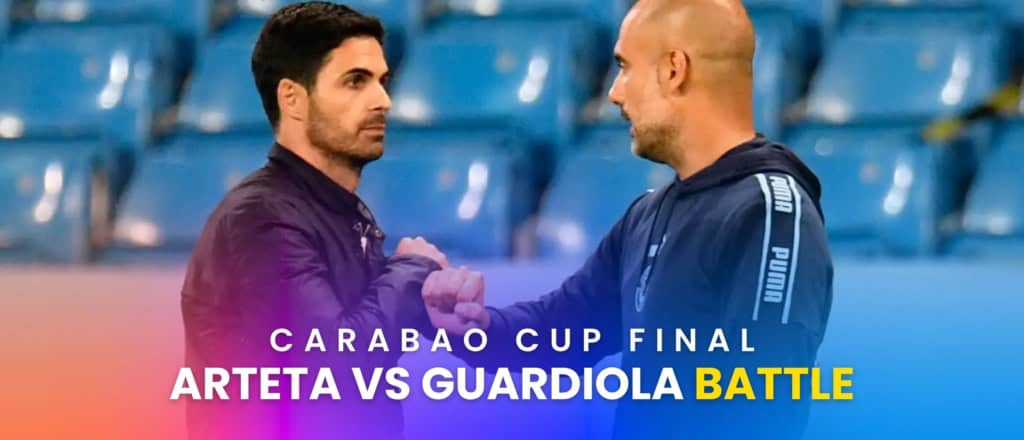
Carabao Cup Final arrives at a defining moment in the season
The Carabao Cup Final between Arsenal and Manchester City lands at a point in the season where context matters more than the trophy itself. This is not just the first major final of the domestic calendar. It is a match that sits directly between momentum and consequence.
Arsenal arrive with control. Their position at the top of the league reflects a team that understands how to manage games, limit risk, and win consistently. They are not chasing form. They are sustaining it. The Carabao Cup Final, in this context, becomes less about proving quality and more about confirming authority.
Manchester City enter from a different angle. Their season has been disrupted rather than derailed, but that distinction matters. A team built on dominance now finds itself needing to respond. Under Pep Guardiola, control has always been the defining trait. The Carabao Cup Final becomes the first real test of whether that control still exists under pressure.
This is why the match carries weight. It is not about lifting a trophy. It is about who dictates the direction of the season from this point forward.
Carabao Cup Final and the shift from performance to consequence
League football allows space for recovery. Over 38 games, teams can absorb setbacks and adjust. Finals do not offer that luxury. The Carabao Cup Final compresses consequence into a single afternoon.
For Mikel Arteta, this shift is critical. Arsenal have spent the past few seasons building a structure that prioritizes control and consistency. But structure alone does not define elite teams. Conversion does. The ability to turn performance into trophies is what separates contenders from winners.
This is where the pressure subtly shifts. Arsenal are no longer judged only on how they play. They are judged on what they win. The Carabao Cup Final becomes the first opportunity this season to answer that question directly.
For Manchester City, the stakes are framed differently. Their recent history has already established credibility. But in elite sport, past success does not protect present standards. It raises them. The Carabao Cup Final becomes a checkpoint, a moment to show that recent setbacks have not altered their competitive identity.
In both cases, the match moves beyond performance. It becomes about consequence.
Carabao Cup Final highlights the difference between control and certainty
One of the most interesting dynamics heading into the Carabao Cup Final is the contrast between control and certainty. Arsenal currently represent control. Their system is clear, their execution consistent, and their approach repeatable across different opponents.
Manchester City, by contrast, represent uncertainty this season. Not in quality, but in output. They still possess the technical and tactical level to dominate any opponent, but their performances have not always reflected that consistently.
This creates a subtle shift in expectations. Arsenal are expected to deliver a certain level. Manchester City are expected to find a way.
The Carabao Cup Final becomes the environment where these expectations are tested. If Arsenal impose their structure, it reinforces the idea that control leads to results. If City disrupt that structure, it reintroduces the idea that experience and adaptability can override consistency.
This is not just a tactical battle. It is a philosophical one.
Carabao Cup Final and the weight of recent history
Recent history plays a quiet but important role in shaping this match. Pep Guardiola has consistently had the upper hand over Mikel Arteta in direct encounters. That record does not decide the outcome, but it influences perception.
For Arsenal, breaking that pattern is part of the challenge. Progress is not only measured in league position. It is also measured in how a team performs against its most significant rival. The Carabao Cup Final offers a chance to change that narrative.
For Manchester City, that history provides a reference point. Even in a season where they have looked less consistent, they retain the knowledge that they have found solutions in this fixture before.
This creates a psychological layer within the match. Arsenal are pushing to establish a new pattern. Manchester City are looking to maintain an existing one.
Carabao Cup Final as a test of identity under pressure
Every top team builds an identity. The real test is whether that identity holds under pressure. The Carabao Cup Final provides exactly that scenario.
Arsenal’s identity is built on structure, discipline, and control of space. They limit transitions, manage tempo, and reduce chaos within games. This approach has brought them consistency, but finals often introduce unpredictability.
Manchester City’s identity is built on positional dominance and technical superiority. Even when results fluctuate, their core principles remain intact. The question is whether those principles can be executed cleanly in a high-pressure, one-off match.
The Carabao Cup Final forces both teams into a situation where identity must translate into outcome. There is no margin for gradual correction. Execution has to be immediate.
Carabao Cup Final and the importance of early control
In matches of this nature, the opening phase often sets the tone. Control in the first twenty minutes can shape the entire rhythm of the game.
For Arsenal, a stable start allows them to settle into their structure. They are at their best when they dictate tempo rather than react to it. Establishing early control reduces the risk of the game becoming open and unpredictable.
For Manchester City, early disruption is often the objective. Breaking rhythm, forcing turnovers, and creating moments of instability can shift the balance quickly.
The Carabao Cup Final will likely be decided by which team imposes its preferred tempo first. This is not about dominance in possession alone. It is about control of moments.
Carabao Cup Final sets the tone for what comes next
Beyond the immediate result, the Carabao Cup Final has implications for the remainder of the season. Arsenal still hold a strong position in the league, but momentum can influence how that advantage is managed.
A win reinforces confidence and strengthens belief. A loss introduces questions, even if it does not directly impact standings.
For Manchester City, the effect is even more pronounced. Victory provides a reset and reestablishes authority. Defeat increases pressure and intensifies scrutiny.
This is what makes the Carabao Cup Final significant. It is not just a standalone event. It is a moment that shapes perception, confidence, and approach heading into the final phase of the season.
Carabao Cup Final as the first true pressure checkpoint
Every season contains moments that define its direction. The Carabao Cup Final is one of those moments.
For Arsenal, it is the first major checkpoint in a campaign that has promised more than it has delivered in recent years. For Manchester City, it is an opportunity to correct course and reassert control.
The outcome will not decide the season. But it will influence how the rest of it is played.
That is why this Carabao Cup Final matters. Not because it is the first trophy available, but because it is the first moment where pressure, expectation, and identity all collide at once.
Mikel Arteta and the shift from project to pressure-tested contender
The rise of Mikel Arteta has moved beyond the language of “project” and into the reality of expectation. What was once framed as long-term rebuilding at Arsenal is now judged in shorter cycles, where performance must regularly convert into trophies. The Carabao Cup Final becomes a clear checkpoint in that transition from development to delivery.
Arteta’s Arsenal are no longer defined by potential alone. They are defined by structure, repetition, and control in high-level matches. That identity has been built deliberately, with emphasis on positional discipline, pressing triggers, and game-state management. The next step in that evolution is not tactical refinement, but competitive confirmation.
In this sense, the Carabao Cup Final is not simply another fixture. It is a stress test for a system designed to win under pressure.
Mikel Arteta and the tactical identity built on control and repetition
One of the clearest characteristics of Arteta’s Arsenal is the consistency of their structure. The team rarely drifts away from its core principles, regardless of opposition. Build-up patterns, pressing intensity, and spacing between lines remain tightly controlled.
This repetition is not accidental. It is the foundation of how Arteta has built stability into a squad that previously lacked it. By reducing variability, Arsenal increase predictability within their own system, which in turn reduces chaos in matches.
However, finals introduce a different kind of challenge. In the Carabao Cup Final, control is not guaranteed simply through structure. It must be maintained under emotional pressure, tactical disruption, and moments of instability.
This is where Arteta’s influence is most visible. His Arsenal are trained to respond to stress with structure rather than improvisation. The question is whether that structure holds when the match becomes fragmented.
Mikel Arteta and the pressure of converting progress into trophies
For managers at the elite level, progress is no longer measured only in improvement. It is measured in silverware. For Arsenal, this shift has been gradual but unavoidable.
Under Arteta, Arsenal have consistently moved closer to title-level performance. They have competed at the top end of the league, challenged in multiple competitions, and established themselves as a consistent force. But the final step—converting that consistency into trophies—remains the defining expectation.
The Carabao Cup Final represents one of the clearest opportunities to address that gap. While it is not the most prestigious competition in isolation, it is often the first tangible step in building a winning habit.
For Arteta, this matters beyond the trophy itself. It is about validating a method. A win would reinforce the idea that Arsenal’s structure is not only effective across a season, but decisive in finals. A loss, however, would reopen familiar questions about execution in decisive moments.
Mikel Arteta and the evolving relationship with elite opposition
A significant part of Arteta’s development as a manager has come through repeated encounters with elite opposition, particularly Manchester City under Pep Guardiola. That relationship has shaped Arsenal’s tactical identity in subtle but important ways.
Early in his tenure, Arsenal often struggled to maintain control against top-tier sides. Over time, that gap has narrowed. The team now approaches these matches with greater tactical confidence and clearer game plans.
However, the Carabao Cup Final introduces a different layer: expectation of parity. Arsenal are no longer outsiders in these encounters. They are direct competitors. That change alters how the match is perceived internally and externally.
Arteta’s challenge is no longer about competing with elite teams. It is about beating them when it matters most.
Mikel Arteta and the importance of game-state management in finals
Modern football at the highest level is increasingly defined by game-state management. Knowing when to accelerate, when to slow down, and when to absorb pressure is critical, especially in finals.
Arteta’s Arsenal have shown strong control in this area across league fixtures. They are capable of managing leads, controlling possession phases, and limiting transitions when ahead.
In the Carabao Cup Final, however, those patterns must survive heightened emotional intensity. Early goals, momentum swings, and momentum resistance all become more significant.
The ability of Arsenal to maintain composure during these phases will likely define their performance. Arteta’s influence will be measured not just in tactical preparation, but in in-game adjustments.
Mikel Arteta and the balance between system discipline and adaptability
A defining tension within Arteta’s managerial approach is the balance between strict system adherence and in-game flexibility. His Arsenal are highly structured, but finals often demand adaptability in response to unexpected developments.
Against a side like Manchester City, rigidity can be both strength and vulnerability. Structure provides stability, but too much dependence on predetermined patterns can limit response speed when games shift.
Arteta’s challenge in the Carabao Cup Final is to maintain the core identity of his team while allowing enough flexibility to respond to tactical shifts. This includes adjusting pressing intensity, modifying build-up routes, and managing transitions more dynamically if required.
The success of Arsenal in this match may depend on how effectively that balance is maintained.
Mikel Arteta and the emotional discipline required for finals football
Beyond tactics, finals are often decided by emotional control. The ability to remain focused under pressure, avoid reactive decisions, and maintain clarity in key moments becomes decisive.
Arteta has placed significant emphasis on emotional discipline within his squad. Arsenal’s improved consistency in high-pressure league fixtures reflects that development.
The Carabao Cup Final, however, introduces a different scale of pressure. It is not just about avoiding mistakes. It is about executing with precision when the stakes are highest.
For Arsenal, this is where Arteta’s long-term work is most directly tested.
Mikel Arteta and the defining moment of tactical credibility
Ultimately, the Carabao Cup Final is not just a match in Arsenal’s season. It is a reference point for how far the team has come under Arteta’s leadership.
Victory would reinforce his tactical credibility at the highest level, confirming that his system can deliver in decisive matches. It would strengthen the perception that Arsenal are no longer building toward success, but actively achieving it.
Defeat would not undo progress, but it would delay validation.
This is why the Carabao Cup Final carries significance for Arteta specifically. It is not just about winning a trophy. It is about proving that Arsenal’s evolution has reached a point where structure, identity, and execution align under maximum pressure.
Mikel Arteta and Pep Guardiola turn the Carabao Cup Final into a tactical referendum
The Carabao Cup Final is rarely just about the teams on the pitch when Mikel Arteta and Pep Guardiola are involved. Their shared history has turned matches between Arsenal and Manchester City into something closer to a tactical referendum than a conventional final.
Arteta is no longer merely a disciple of Guardiola. That phase is over. The Carabao Cup Final represents a more complex reality: student and mentor now operating as rivals at the same competitive altitude. Every decision, from pressing structure to in-game adjustments, carries an additional layer of meaning because of that relationship.
This is why the match feels heavier than its title suggests. It is not just Arsenal versus Manchester City. It is Arteta’s system versus Guardiola’s system, tested under final-day pressure.
Mikel Arteta and the attempt to outgrow Guardiola’s blueprint
Much of Arteta’s managerial identity was originally shaped within Guardiola’s tactical environment at Manchester City. That influence is visible in Arsenal’s structure: positional discipline, inverted full-backs, controlled build-up phases, and structured pressing.
But the Carabao Cup Final highlights an important evolution. Arteta is no longer copying the model. He is refining it. Arsenal’s version of positional football is more direct in certain phases, more vertical in transitions, and more aggressive in defensive moments compared to Guardiola’s traditional approach.
This evolution matters because it reflects independence. The Carabao Cup Final becomes a measure of whether Arteta’s adaptations are strong enough to compete directly with the originator of the system.
Guardiola, by contrast, remains committed to constant tactical refinement within his established principles. His Manchester City side are less about replication and more about reinvention within a framework. That contrast defines the match.
Mikel Arteta and Guardiola’s chess match on the touchline
The tactical battle in the Carabao Cup Final will not only be played on the pitch. It will unfold continuously on the sidelines. Both managers are known for in-game adjustments that shift the rhythm of matches.
For Manchester City, Guardiola’s strength lies in manipulating space through positional rotations. His teams create overloads in unexpected areas, forcing opponents to constantly adjust their defensive shape.
For Arsenal, Arteta’s response has been to tighten structural discipline while improving transition speed. Rather than chasing City’s positional complexity, Arsenal often aim to disrupt it by reducing time on the ball and compressing central space.
The Carabao Cup Final becomes a test of which approach holds under pressure. Guardiola seeks to stretch structure until it breaks. Arteta seeks to compress space until control is regained.
Mikel Arteta and the psychological weight of facing his mentor
Beyond tactics, there is a psychological dimension that cannot be ignored. For Mikel Arteta, matches against Guardiola carry a unique emotional complexity. He has worked within the system that defined modern positional football at its peak, but now stands in opposition to it.
This creates a subtle tension: familiarity versus independence. Arteta understands Guardiola’s methods at a deeper level than most opponents, but that knowledge does not guarantee advantage. It simply changes the nature of the contest.
For Guardiola, the dynamic is different but equally significant. He is now managing against a former assistant who has internalised his ideas and reshaped them into something distinct. That creates an unusual challenge: facing a version of your own philosophy, refined and adapted for a new environment.
The Carabao Cup Final becomes, in this sense, less about surprise and more about execution under mutual understanding.
Mikel Arteta and the tactical battleground of midfield control
Midfield control is likely to be the decisive battlefield in the Carabao Cup Final. Both managers build their teams around controlling central zones, but they approach it differently.
Guardiola’s Manchester City tend to prioritise positional superiority. They create numerical advantages through rotation and spacing, allowing them to dictate tempo and sustain possession.
Arteta’s Arsenal focus more on structured pressing traps and rapid transitions once possession is won. Their aim is not always to dominate possession, but to control the moments within it.
This creates a fascinating contrast. One system seeks continuous control. The other seeks controlled disruption.
Whichever approach wins midfield control will likely dictate the rhythm of the Carabao Cup Final.
Mikel Arteta and Guardiola’s evolution meeting at the same point
What makes this Carabao Cup Final particularly significant is timing. Both managers are no longer in the early stages of their tactical development. They are operating at peak maturity.
Guardiola has already revolutionised modern football. His challenge now is maintenance through adaptation. Arteta, meanwhile, is still in the phase of proving that his adaptations can produce consistent silverware at elite level.
This convergence creates balance. For the first time, the gap between them is not defined by hierarchy, but by execution on the day.
The Carabao Cup Final becomes a rare moment where influence and independence collide on equal footing.
Mikel Arteta and the fine margins of elite tactical decision-making
At this level, matches are often decided by small adjustments rather than major changes. A press triggered five seconds earlier. A defensive line held five metres higher. A substitution that shifts midfield balance.
Arteta’s Arsenal and Guardiola’s City both operate in this space of fine margins. The Carabao Cup Final will likely hinge on which manager reads those margins more accurately in real time.
Arteta’s recent growth has been visible in his ability to adjust mid-game without destabilising structure. Guardiola’s long-standing strength is anticipating those shifts before they happen.
This creates a dynamic where preparation and reaction constantly overlap.
Mikel Arteta and the question of tactical maturity under pressure
The final layer of this rivalry is maturity under pressure. It is one thing to implement a system across a season. It is another to execute it in a final where every mistake is magnified.
For Arteta, the Carabao Cup Final represents a test of whether his tactical identity can withstand maximum pressure without deviation. For Guardiola, it is a test of whether his system still maintains superiority in evolving conditions.
There is no neutral outcome in this context. One approach will look validated. The other will be questioned.
Mikel Arteta and the Carabao Cup Final as a turning point in modern managerial rivalry
Ultimately, the Carabao Cup Final is not just another meeting between Arsenal and Manchester City. It is a continuation of one of football’s most influential managerial relationships.
For Mikel Arteta, it is an opportunity to move from tactical inheritance to tactical authority. For Pep Guardiola, it is a reminder that influence inevitably produces competition.
For both, the outcome will shape perception far beyond a single trophy.
This is why the Carabao Cup Final matters: not because it ends a competition, but because it measures how far one idea has evolved from another.
Carabao Cup Final shifts from narrative fixture to performance verdict
The Carabao Cup Final between Arsenal and Manchester City stops being a theoretical battle the moment kickoff approaches. At that point the focus moves away from prediction and settles entirely on execution under pressure.
For Mikel Arteta and Pep Guardiola the match is no longer about systems in isolation. It becomes about whether those systems can survive the intensity and unpredictability of a final.
Arsenal arrive with structure and momentum. Manchester City arrive with experience and expectation. The contrast between those two states is what defines the entire occasion.
Execution becomes more important than dominance in the Carabao Cup Final
At this level dominance does not guarantee control of the result. Teams can dominate possession and territory without translating it into victory. The Carabao Cup Final reduces everything to execution in key moments.
Arsenal under Arteta have built their identity on structure and control across phases of play. When they dictate tempo they reduce chaos and increase stability. That stability is one of their greatest strengths.
Manchester City under Guardiola rely on positional control and technical superiority. Their approach is designed to stretch opponents and create constant pressure through structure and movement.
In a final both approaches are tested in conditions where small disruptions can change the entire flow of the match.
Carabao Cup Final and the pressure placed on Mikel Arteta’s evolution
For Mikel Arteta this stage represents a shift in responsibility. Arsenal are no longer judged only on improvement. They are judged on outcomes.
That shift changes the meaning of performance. Progress alone is no longer enough. It must be validated through trophies.
Carabao Cup Final and Manchester City’s demand for authority restoration
For Manchester City the pressure is different. Their identity under Pep Guardiola is built on sustained dominance and constant success.
That level of expectation means even small drops in performance become significant talking points. Every final is an opportunity to reassert control and restore rhythm.
The Carabao Cup Final offers City a chance to reaffirm their standards. It is not about proving they belong at the top. It is about showing they still define it.
Carabao Cup Final and the importance of momentum within key moments
Modern finals are rarely decided by overall superiority. They are decided by short phases where momentum shifts quickly.
A set piece. A counterattack. A brief loss of structure. These moments often decide outcomes more than long spells of control.
Arsenal will aim to minimise instability by maintaining structure and discipline. Manchester City will aim to create openings through sustained pressure and movement.
The team that manages these key moments more effectively will likely control the result.
Carabao Cup Final and the final test of managerial identity
For Mikel Arteta the match is a test of whether his philosophy can consistently translate into trophies at the highest level.
For Pep Guardiola it is another stage in a career already defined by sustained success but still constantly under scrutiny in every competition.
Their shared history adds context but does not decide the outcome. What matters is execution on the day.
The Carabao Cup Final becomes a meeting point between two managerial identities under maximum pressure.
Carabao Cup Final closes as a measure of control under pressure
After the final whistle the interpretation begins. For Arsenal the question will be whether structure has become silverware. For Manchester City the question will be whether authority remains intact.
In both cases the Carabao Cup Final functions as a benchmark of delivery rather than ability.
At this level football is not only about how teams play. It is about whether they deliver when everything is on the line.


Responses