

Royal Challengers Bengaluru IPL 2026 Return Home With Well Earned Title

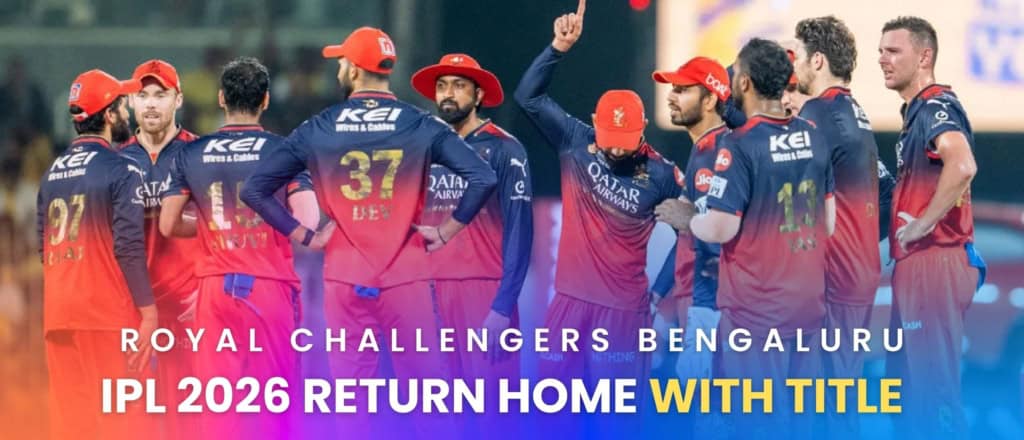
From long-term pursuit to immediate expectation reality
Royal Challengers Bengaluru enter IPL 2026 in a fundamentally altered competitive identity, shifting from a franchise defined by pursuit to one defined by preservation. Their long-awaited IPL title victory over Punjab Kings did not simply end an 18-season drought; it reset the psychological and structural baseline of the entire organisation.
For nearly two decades, RCB operated under a consistent narrative of incompletion, where strong squad builds, elite individual performances, and multiple finals appearances failed to translate into sustained championship success. That cycle shaped every layer of their competitive identity, from decision-making under pressure to squad construction philosophy.
Winning the title changed that foundation instantly. The franchise is no longer evaluated through the lens of “can they win” but instead through “can they repeat.” This shift is subtle in language but significant in competitive reality. Defending champions operate under a different psychological and tactical burden compared to challengers because expectation replaces ambition as the dominant force driving performance.
This transition forces RCB into a new structural phase where consistency becomes more valuable than breakthrough performance.
Emotional residue of triumph and the complexity of post-championship identity
While the title victory represented a historic breakthrough, the emotional environment surrounding it did not resolve into simple celebration. The aftermath of RCB’s championship win was marked by events that extended beyond the cricketing sphere and deeply affected the collective atmosphere around the franchise.
What should have been a moment of consolidated success and sustained celebration instead became a period of emotional disruption and reflection. The impact of those events reshaped how the franchise interacts with its own success, introducing an additional layer of emotional responsibility that now sits alongside competitive expectation.
This creates a rare situation in elite sport where a team must simultaneously process triumph and its consequences while preparing for immediate competitive defence of that success. Unlike conventional champions who build forward from a clean celebratory foundation, RCB enter IPL 2026 carrying both achievement and emotional complexity.
That duality has a direct influence on team psychology, preparation rhythm, and institutional focus heading into the new season.
The redefined meaning of home at M Chinnaswamy Stadium
The return to M Chinnaswamy Stadium ahead of IPL 2026 represents more than a logistical homecoming. It signals the reactivation of a venue that has undergone both structural reassessment and emotional recalibration.
Historically, the stadium has functioned as one of the most intense home environments in franchise cricket, where crowd energy often plays a decisive role in shaping momentum and performance patterns. The relationship between RCB and their home venue has always been deeply intertwined with emotional intensity, often amplifying both success and pressure.
However, following post-championship restructuring and revised safety protocols implemented under the Karnataka State Cricket Association, the stadium environment now operates under a more controlled framework. This does not diminish its significance but alters its functional dynamics.
Home advantage is no longer purely emotional or crowd-driven. It now exists within a regulated structure where safety, organisation, and controlled access shape the matchday atmosphere as much as fan intensity.
For RCB, this means their traditional reliance on emotional momentum must now be balanced with a more system-oriented understanding of home conditions
Leadership continuity through Virat Kohli’s stabilising presence
Within this evolving structural environment, Virat Kohli remains the central stabilising force for Royal Challengers Bengaluru. His presence provides continuity across a franchise that has now transitioned from historical inconsistency into championship expectation.
Kohli’s influence extends beyond batting output or match situations. It functions as a behavioural framework that defines intensity standards, competitive discipline, and response patterns under pressure. In teams undergoing identity transitions, such leadership continuity becomes essential in preventing performance volatility.
Ahead of IPL 2026, his role becomes even more significant because the team is no longer building toward validation but defending established success. This requires a different psychological approach, one that balances aggression with control and intensity with sustainability.
Head coach Andy Flower complements this structure by providing tactical organisation and systemic clarity, ensuring that emotional leadership is translated into structured performance execution.
Together, they form the core stabilisation axis of RCB’s title defence architecture.
Early squad uncertainty and structural balance considerations
Despite entering the season as defending champions, RCB face early structural challenges that directly influence squad balance and tactical flexibility. The most significant of these is the uncertain availability of Josh Hazlewood, whose injury recovery timeline remains unclear following extended issues involving Achilles and hamstring complications.
Hazlewood’s absence would represent more than the loss of a frontline bowler. It would remove a key control mechanism within the bowling unit, particularly in phases requiring disciplined execution under pressure. His role in the previous campaign contributed significantly to structural balance across powerplay and middle overs.
Additional uncertainty surrounds Yash Dayal, whose absence from training environments raises further questions about left-arm pace depth and tactical variation within the bowling attack.
These variables increase the importance of squad depth and contingency planning. Players such as Jacob Duffy and Bhuvneshwar Kumar gain heightened strategic relevance, not as replacements but as structural stabilisers within the broader bowling system.
This early uncertainty sets the tone for RCB’s IPL 2026 campaign, where depth and adaptability may prove as important as established match-winners
Defending champions under shifted competitive gravity
Royal Challengers Bengaluru’s entry into IPL 2026 introduces a fundamentally different competitive environment compared to their title-winning campaign. The transition from challengers to defending champions alters the gravitational centre of expectation, where every opposition team now approaches fixtures against RCB with elevated tactical intensity and psychological motivation.
In franchise cricket, defending champions no longer operate in neutral competitive space. They become the reference point for opposition strategy, meaning every opponent structures preparation around dismantling their core strengths rather than simply competing on equal footing. This shift increases the tactical burden on RCB across every phase of the game.
Instead of surprise and momentum-driven performance that often benefits challengers, RCB must now operate within a system where their patterns are studied, anticipated, and specifically targeted. This requires not just consistency but adaptive variation in execution, particularly in bowling combinations and middle-order flexibility.
The psychological weight of defending a title also introduces a different internal pressure dynamic. Players are no longer performing to achieve history; they are performing to preserve it. That distinction often influences decision-making in high-pressure overs, particularly in close match situations where conservative choices may replace assertive execution.
Powerplay structure and early overs control dependency
One of the most critical tactical layers for Royal Challengers Bengaluru in IPL 2026 is their powerplay structure, particularly given the uncertainty surrounding key bowling personnel. The absence or reduced availability of Josh Hazlewood significantly impacts their ability to establish early control through disciplined new-ball bowling.
Hazlewood’s previous role extended beyond wicket-taking. He functioned as a stabilising force who ensured that opposition scoring rates were contained during the most volatile phase of T20 innings construction. Without that level of control, RCB’s powerplay structure becomes more dependent on secondary seam options and situational matchups.
This increases the importance of experienced operators like Bhuvneshwar Kumar, whose ability to control swing conditions and execute variations at both ends of the powerplay becomes central to maintaining structural balance. However, reliance on experience alone does not fully replicate the pressure control that elite powerplay specialists provide.
As a result, RCB’s early overs strategy in IPL 2026 may require greater field-based adaptability and rotational bowling approaches to compensate for reduced predictability in execution
Middle-overs control and the role of transitional stability
Beyond the powerplay, the middle overs represent the most structurally sensitive phase of RCB’s campaign. This phase determines whether early control can be converted into sustained pressure or whether opposition teams regain momentum through rotation and boundary accumulation.
In their championship-winning season, RCB demonstrated improved ability to manage this phase through disciplined spin-seam rotation and controlled field placement strategies. However, maintaining that control becomes more complex in IPL 2026 due to increased opposition familiarity with their tactical patterns.
Teams now approach RCB with detailed understanding of their middle-overs structure, particularly their reliance on specific matchup-based bowling rotations. This reduces the element of surprise and increases the need for in-game adaptability.
The effectiveness of players like Jacob Duffy, if integrated into the XI, becomes highly dependent on their ability to disrupt opposition rhythm rather than simply contain runs. In modern T20 frameworks, middle-overs success is defined less by economy alone and more by the ability to break partnership flow and force structural resets in batting units
Squad depth as a structural necessity rather than strategic advantage
One of the defining characteristics of defending champions in franchise cricket is the transformation of squad depth from a competitive advantage into a structural necessity. For Royal Challengers Bengaluru, this shift is particularly relevant given early uncertainties around pace bowling availability and workload distribution.
Unlike previous seasons where RCB could rely on a more defined core XI with limited variation, IPL 2026 demands a more flexible rotation model. This means that bench strength is no longer secondary; it becomes integral to maintaining performance consistency across a long tournament cycle.
Players outside the established core are now expected to contribute in high-pressure scenarios rather than situational appearances. This includes adapting quickly to different pitch conditions, opposition matchups, and match-state requirements.
The success of this model depends heavily on how effectively RCB can integrate contingency options without disrupting overall structural cohesion. Teams that fail in this area often experience performance volatility during mid-season phases when injuries and form fluctuations begin to accumulate.
Tactical evolution under Andy Flower’s system-based coaching approach
Under head coach Andy Flower, RCB’s tactical framework continues to emphasise system-based clarity rather than reactive improvisation. His coaching philosophy prioritises structured decision-making processes, where players operate within clearly defined tactical roles that adjust based on match state rather than instinct alone.
In the context of IPL 2026, this approach becomes particularly important because defending champions face reduced margin for error. Opponents are more likely to exploit structural weaknesses that remain consistent across matches, making predictability a potential vulnerability.
Flower’s system aims to counter this by embedding flexibility within structure. This includes role fluidity in batting order construction, rotational bowling deployment, and adaptive field setting frameworks designed to respond to match-phase shifts.
However, the effectiveness of such systems depends on execution discipline at player level. In high-pressure T20 environments, even well-designed tactical systems can break down if individual execution does not align with structural intent.
Emerging pressure patterns across franchise identity
As RCB transition into IPL 2026, a broader pattern emerges that defines their current franchise identity: the shift from emotional ambition to structural expectation management. This is a critical phase in the lifecycle of any championship-winning team, where internal standards are recalibrated to match external expectations.
For RCB, this transition is intensified by their historical context. A franchise that spent years attempting to overcome failure narratives now faces the challenge of sustaining success narratives under continuous scrutiny.
This creates a dual-pressure environment where performance is evaluated not only on results but also on consistency, adaptability, and control under varying match conditions. In such environments, marginal tactical decisions often carry amplified consequences.
The ability to navigate this pressure landscape will define whether RCB’s title win becomes the foundation of a sustained era or an isolated peak within a historically inconsistent trajectory
The inevitability of expectation and the psychology of defending success
Royal Challengers Bengaluru’s 2026 campaign begins with a structural reality that distinguishes defending champions from all other competitors in franchise cricket: expectation is no longer external, it is embedded. After finally securing their first IPL title, RCB now operate in an environment where every performance is measured against the standard they themselves created.
This shift alters the psychological baseline of the squad. In previous seasons, momentum was built through underdog energy and the absence of definitive external pressure to maintain a championship identity. Now, however, every match carries implicit judgment about whether the team is still functioning at a title-winning level.
This creates a sustained psychological load that does not fluctuate with individual results. Even victories are evaluated through performance quality rather than outcome alone, meaning the margin between success and perceived instability becomes narrower across the season.
High-performance maintenance under reduced structural margin for error
Defending champions in IPL environments typically experience a reduction in structural tolerance. Opponents target weaknesses more aggressively, tactical patterns are studied in greater detail, and internal performance benchmarks rise due to heightened expectation.
For RCB, this means that their systems must now operate with higher precision thresholds. Minor breakdowns in powerplay control, middle-over containment, or death-phase execution are more likely to be punished due to increased opposition preparation intensity.
This reduces the effectiveness of recovery-based cricket, where teams traditionally compensate for early errors through mid-innings correction. Instead, consistency across all phases becomes a mandatory requirement rather than an ideal outcome.
In this context, squad depth is not simply about rotation flexibility but about ensuring that structural performance does not degrade when frontline resources are unavailable or underperforming.
Bowling structure fragility and adaptive reliance patterns
The uncertainty surrounding key bowling personnel places additional strain on RCB’s structural balance heading into IPL 2026. Without consistent availability from their primary pace leader, the responsibility for control shifts across multiple bowlers rather than being concentrated within a single stabilising figure.
This redistribution of responsibility creates both opportunity and risk. On one hand, it allows for diversified matchups and situational flexibility. On the other hand, it increases dependency on collective discipline rather than individual control excellence.
Bhuvneshwar Kumar’s role becomes central in this environment, not just as a bowler but as a structural stabiliser who can absorb pressure across different phases of the innings. Similarly, emerging or rotational options must adapt quickly to high-intensity environments where execution accuracy is heavily scrutinised.
The success of this bowling structure depends on whether RCB can maintain coherence across changing personnel combinations without losing tactical clarity
Batting identity stability and pressure distribution across innings phases
While much of the structural uncertainty heading into IPL 2026 is concentrated in the bowling unit, RCB’s batting identity also carries its own pressure distribution challenges. As defending champions, their batting unit is now expected to deliver both stability and acceleration across varied match conditions.
This dual expectation creates a layered responsibility structure within the batting order. Top-order players must provide foundation stability, while middle-order batters are required to convert platform starts into decisive match control. Any deviation from this pattern is more heavily scrutinised in a title-defence season than in a chasing campaign.
The psychological difference is significant. In previous seasons, explosive innings could compensate for structural inconsistencies. In a defending champion framework, however, inconsistency itself becomes the primary concern, even if isolated performances remain strong.
This places emphasis on role clarity and execution discipline across all batting positions.
Leadership alignment and system reinforcement under pressure cycle
Virat Kohli’s leadership presence, combined with Andy Flower’s structured coaching methodology, forms the central alignment axis through which RCB’s IPL 2026 campaign is stabilised. This dual framework is critical in managing pressure cycles that naturally intensify during title defence seasons.
Kohli’s influence ensures emotional intensity remains high without devolving into reactive decision-making. Flower’s system ensures that tactical decisions remain consistent across varying match states, reducing the risk of structural drift during high-pressure phases.
Together, they provide the balance required for a team transitioning from historical pursuit to sustained expectation management. However, this balance must be continuously reinforced throughout the season, particularly during periods of injury disruption or form volatility.
Final convergence: from champions to sustained contenders
The defining challenge for Royal Challengers Bengaluru in IPL 2026 is not achieving success, but sustaining it under conditions that actively resist repetition. Championship-winning teams often face a natural regression risk due to increased scrutiny, tactical predictability, and psychological fatigue associated with defending success.
For RCB, this risk is compounded by early squad uncertainties and the emotional complexity surrounding their recent history. The combination of structural adjustment, leadership responsibility, and competitive pressure creates a multi-layered environment where stability must be actively constructed rather than assumed.
If RCB successfully navigate these conditions, their 2025 triumph will be redefined not as an isolated peak but as the beginning of a sustained competitive era. If they fail to adapt, it will remain a landmark achievement surrounded by the difficulties of defending a newly established identity.
In either outcome, IPL 2026 becomes the defining test of whether Royal Challengers Bengaluru have truly transitioned from aspirational contenders into structurally resilient champions.
Written by 8jjsports | March 21, 2026
Stay updated with 8JJ for Real-Time Sports Scores & Sports Related Updates


Responses