

Babar Azam: 5 Explosive Questions After Hesson Remark

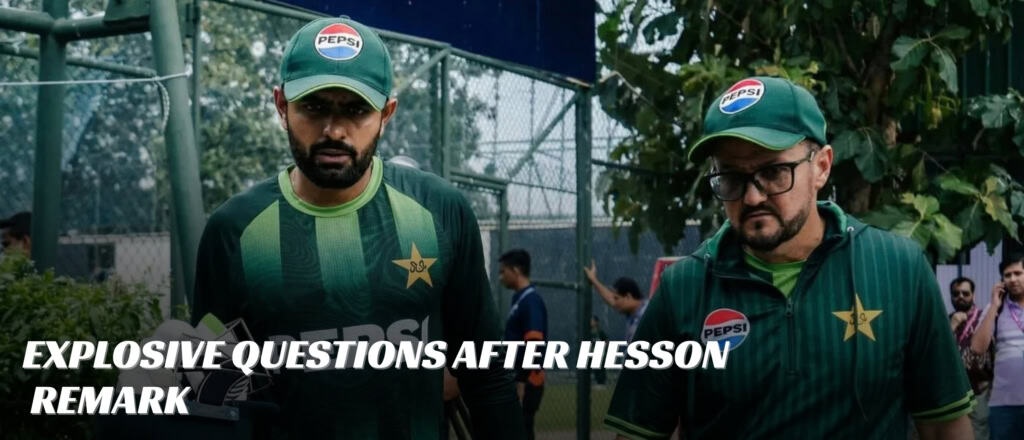
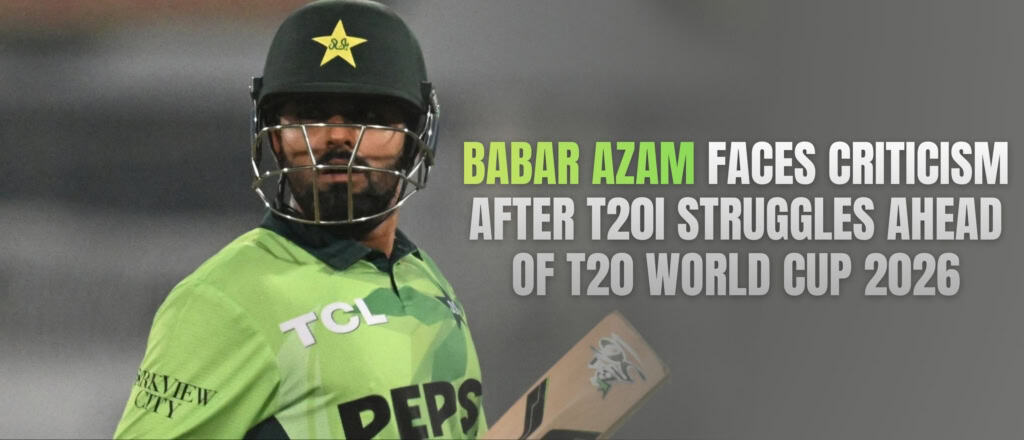
Babar Azam has found himself at the center of a storm in the T20 World Cup 2026 after five explosive questions were raised following head coach Mike Hesson’s striking remarks about his strike rate and role in the Pakistan team. The controversy has intensified debates around Babar Azam’s position, purpose, and long-term future in Pakistan’s T20I setup. As Pakistan navigate the crucial Super Eight stage of the T20 World Cup 2026, Babar Azam’s batting role has become one of the most discussed topics in cricket circles. From powerplay struggles to middle-order adjustments, the scrutiny surrounding Babar Azam continues to grow.
T20 World Cup 2026: Why Is Babar Azam Under Fire?
The T20 World Cup 2026 campaign has not unfolded smoothly for Babar Azam. He scored 15 against the Netherlands, followed by 46 against the USA, before managing just five against India. These numbers, combined with concerns over strike rate, triggered changes in the batting order.
Pakistan team management decided to demote Babar Azam from his earlier No.4 position. In the subsequent group match against Namibia, he did not get an opportunity to bat, while Khawaja Nafay and Shadab Khan occupied the middle-order slots.
This reshuffle in the T20 World Cup 2026 has raised pressing questions about how Pakistan view Babar Azam’s role moving forward.
Mike Hesson’s Statement On Babar Azam Strike Rate
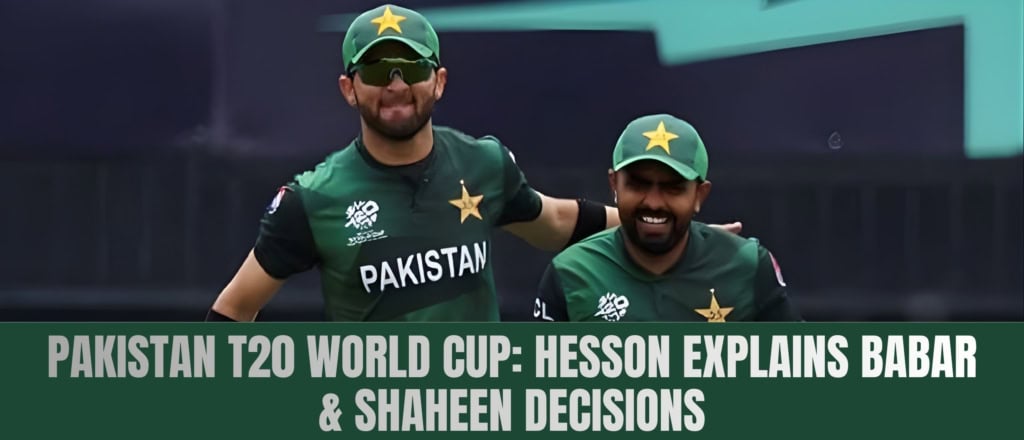
The debate escalated when Mike Hesson publicly addressed Babar Azam’s strike rate in T20 World Cup tournaments. He pointed out that Babar’s strike rate in the powerplay during World Cups has been under 100 a statistic that does not align with Pakistan’s desired aggressive template.
Hesson explained that Babar is better suited to stabilizing innings during difficult phases rather than attacking from the outset. According to the coach, the team requires explosive starts in the first six overs and specialized hitters in the death overs.
By defining Babar Azam as a middle-overs “batsman through the middle,” Hesson attempted to justify the strategic adjustment during the T20 World Cup 2026.
Mohammad Hafeez Fires Back At Pakistan Coach
Former Pakistan captain Mohammad Hafeez strongly criticized Hesson’s remarks, intensifying the Babar controversy. Hafeez questioned the logic behind retaining Babar in the playing XI if he is deemed unsuitable for the powerplay and ineffective beyond the 10th over.
His pointed question “Why is he playing?” echoed across media platforms and reignited debate about Babar Azam’s defined role in the T20 World Cup 2026.
Hafeez’s comments reflect a broader concern among former cricketers that clarity in role definition must not undermine a player’s overall contribution.
Is Babar Azam’s Role Clearly Defined?
The central issue in the T20 World Cup 2026 controversy is whether Babar Azam’s role is clearly structured. If he is not opening and is not considered ideal for the death overs, critics argue that his responsibilities remain ambiguous.
Supporters of Babar believe his technique and temperament make him indispensable, especially in high-pressure tournaments. His ability to anchor innings and rotate strike can provide stability when wickets fall early.
However, modern T20 cricket increasingly demands high strike rates across all phases, and this evolution has influenced Pakistan’s strategy in the T20 World Cup 2026.
The Impact Of Rain And Super Eight Calculations
Complicating matters further, Pakistan’s first Super Eight clash against New Zealand in the T20 World Cup 2026 was abandoned due to rain in Colombo. The washout resulted in shared points, tightening the qualification race.
With England and Sri Lanka remaining in the Super Eight stage, Pakistan must secure victories to strengthen semifinal hopes. In such a high-stakes scenario, every batting position, including Babar Azam’s, comes under scrutiny.
The team’s success in the T20 World Cup 2026 may hinge on whether Babar can deliver impactful performances under mounting pressure.
Balancing Experience And Aggression In T20I Cricket
Babar Azam’s career has been defined by consistency and classical stroke play. Yet the T20 World Cup 2026 has exposed the tension between experience and modern aggression.
Pakistan appear to be transitioning toward a more power-oriented approach in T20I cricket. In this system, anchors must adapt by accelerating earlier and maintaining higher strike rates.
Babar Azam’s supporters argue that his adaptability should not be underestimated. A single match-winning innings could quickly shift narratives and silence critics.
Team Dynamics And Dressing Room Confidence
Despite public criticism, there is no indication of discord within the Pakistan camp. Hesson emphasized that Babar understands his skill set and accepts the role assigned to him.
Strong dressing-room communication is essential in tournaments like the T20 World Cup 2026. Public debates may intensify scrutiny, but internal alignment can help maintain focus.
If Pakistan qualify for the semifinals, the Babar controversy could be reframed as a strategic masterstroke rather than a miscalculation.
What Lies Ahead For Babar Azam
The coming matches in the T20 World Cup 2026 will define Babar Azam’s immediate future in Pakistan’s T20I setup. A commanding innings in the Super Eight stage could reaffirm his importance and quiet critics like Hafeez.
Conversely, continued inconsistency may strengthen calls for a more aggressive restructuring of the batting lineup.
In elite tournaments, reputations are shaped by decisive performances. For Babar Azam, the remaining fixtures offer an opportunity to respond through performance rather than words.
A Defining Phase In T20 World Cup 2026
The Babar Azam debate reflects the broader evolution of T20 cricket. As the T20 World Cup 2026 unfolds, Pakistan must strike the right balance between traditional batting stability and modern power-hitting demands.
Mike Hesson’s remarks, Mohammad Hafeez’s criticism, and ongoing fan discussions have placed Babar Azam under intense spotlight. Yet cricket remains a results-driven sport.
If Babar Azam rises to the occasion and delivers in crucial Super Eight matches, the narrative could shift dramatically. Until then, the T20 World Cup 2026 will continue to test not only Pakistan’s strategy but also the resilience of one of its most accomplished batters.

Responses