

England Seal Comeback Win Over New Zealand as Black Caps’ Semi-Final Fate Hangs in Balance

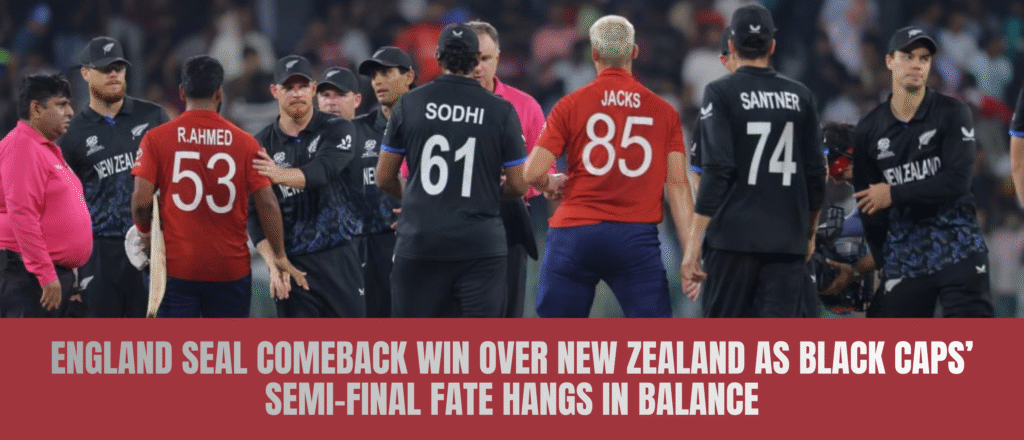
England sealed their comeback win by defeating the New Zealand national cricket team with four wickets in their final Super Eight clash of the ICC Men’s T20 World Cup 2026 in Colombo. The result strengthened England’s position as title contenders and left New Zealand’s semi final qualification hopes hanging in the balance.
The victory marked England’s third consecutive win in the Super Eight stage and reinforced the consistency that has defined their campaign. Although they had already secured qualification for the knockout phase, the manner of this result carried added significance. Eng were forced to recover from a difficult position during the chase, demonstrating both depth and composure under pressure. Their ability to regain control in challenging circumstances reflected the structure and flexibility that has become central to their approach in T20 cricket.
Early setbacks test England’s chase discipline
After being asked to chase a target of 160, the Eng national cricket team encountered early setbacks. The top order struggled to establish momentum, and the loss of key wickets reduced them to 58 for 4. At that stage, New Zealand had an opportunity to assert control and apply sustained pressure. Instead, England’s middle order responded with discipline, focusing on stabilizing the innings before accelerating at the right moment.
A significant contribution came from Will Jacks, whose all round performance proved decisive. Earlier in the match, he played an important role with the ball, finishing with figures of 2 for 23. His off spin was effective in disrupting New Zealand’s scoring rhythm, and he maintained control during a critical phase of the innings. Later, his unbeaten 32 from 18 balls provided the finishing momentum Eng needed to complete the chase. His innings included four boundaries and a six, combining calculated shot selection with controlled aggression.
England’s spin attack shapes the match
England’s bowling performance was equally important in shaping the result. Spin played a central role, with Adil Rashid and Rehan Ahmed both taking two wickets. Their ability to vary pace and maintain accuracy prevented New Zealand from building sustained partnerships. The conditions in Colombo offered assistance to spin bowlers, and England’s tactical use of their spin options allowed them to take full advantage. Notably, all seven New Zealand wickets fell to spin, underlining the effectiveness of England’s strategy.
New Zealand’s innings began with positive intent. Glenn Phillips top scored with 39 from 28 deliveries, while Tim Seifert added 35 and Finn Allen contributed 29. These efforts provided a solid foundation, but England’s bowlers gradually reduced scoring opportunities and prevented the acceleration typically required in the later overs of a T20 innings. As a result, New Zealand finished on 159 for 7, a competitive but not dominant total.
England’s response required contributions across the batting order. Tom Banton scored 33 runs to help rebuild after the early wickets, while Sam Curran added 24, supporting the recovery during the middle phase of the chase. These innings ensured that Eng remained within reach of the target while preserving wickets for the closing overs.
Late acceleration seals England’s momentum
The turning point came during the final phase, when England shifted from consolidation to acceleration. Jacks led this transition, scoring quickly and reducing the required run rate. He was supported by Ahmed, whose late cameo helped ensure there was no further shift in momentum. England reached the target in 19.3 overs, completing the chase with four wickets remaining.
Beyond securing another win, the result carries broader implications for the tournament standings. England advance to the semi finals with strong momentum, having demonstrated effectiveness with both bat and ball throughout the Super Eight stage. Their performances have reflected a balanced lineup capable of adapting to different match situations and conditions.
For New Zealand, the defeat introduces uncertainty. Their progression now depends on other results within the group, highlighting the competitive nature of the tournament’s later stages. While they delivered periods of strong play, their inability to maintain control during key moments ultimately proved costly.
England, meanwhile, will take confidence from their ability to recover under pressure. Their recent performances suggest a team that is well prepared for the demands of knockout cricket, with multiple players capable of influencing outcomes in different roles.





Responses