

Could MS Dhoni See A Possible Return With The CSK This Thrilling IPL 2026 Season?

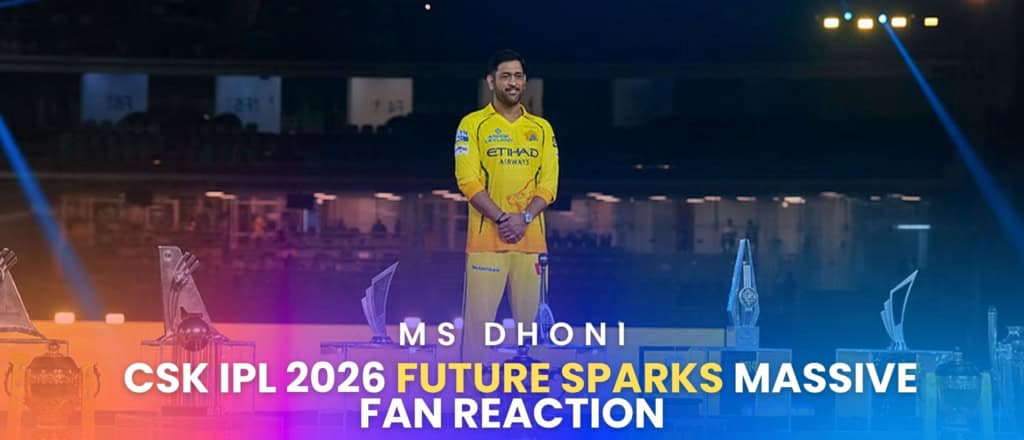
MS Dhoni and the evolution from captaincy authority to institutional permanence
MS Dhoni enters IPL 2026 as a figure whose influence no longer fits within traditional definitions of active cricketing performance. At this stage of his career, his value for Chennai Super Kings is not primarily derived from runs scored, dismissals effected, or on-field tactical interventions. Instead, MS Dhoni functions as an institutional constant, a stabilising axis around which the franchise continues to organise its identity, emotional structure, and competitive culture.
Even as CSK transition through a period of squad restructuring and leadership redistribution under Ruturaj Gaikwad, MS Dhoni remains deeply embedded in the foundational architecture of the team. His presence is not limited to matchday visibility or ceremonial association. It extends into the psychological continuity of the squad, shaping how players interpret pressure, how the dressing room maintains equilibrium, and how the franchise positions itself within the wider IPL ecosystem.
The significance of MS Dhoni in IPL 2026 lies in this shift from active captaincy authority to institutional permanence. During his leadership era, he established a framework built on composure, clarity of roles, and controlled aggression under pressure. Those principles did not disappear with the end of his formal captaincy. Instead, they became embedded in CSK’s operational DNA, continuing to influence decision-making structures long after the captaincy baton was passed.
This is why MS Dhoni remains central to CSK’s identity even in a transitional phase. The franchise does not merely remember his leadership period; it continues to operate within the behavioural systems he helped define. That continuity becomes especially important in IPL 2026, where CSK are balancing the dual demands of rebuilding competitive consistency while preserving their long-standing cultural stability.
The recent attention around MS Dhoni once again highlights this unique positioning. A casual fan interaction in which he was asked whether he could continue playing until the age of 60 generated widespread engagement not because of its literal sporting feasibility, but because it reinforced the symbolic perception of continuity he represents. His response, understated and calm, reflected the same behavioural pattern that has defined his public presence for years: measured ambiguity paired with emotional resonance.
In the context of CSK, even informal moments involving MS Dhoni are absorbed into a larger narrative structure where legacy and present identity are continuously interconnected.
The emotional architecture of MS Dhoni CSK IPL 2026 and its cultural reinforcement cycle
The relationship between MS Dhoni and Chennai Super Kings supporters operates as one of the most emotionally sustained connections in franchise cricket. It is not episodic, nor is it dependent on short-term performance cycles. Instead, it is built on long-term emotional reinforcement that spans multiple generations of CSK’s competitive journey.
In IPL 2026, MS Dhoni continues to function as the central emotional anchor of this system. His presence ensures that fan engagement does not fluctuate solely based on match outcomes or seasonal performance trends. Instead, engagement is continuously reinforced through the symbolic continuity he represents.
This is particularly evident in how supporters interpret his public appearances and statements. The suggestion that he could continue playing until 60, although clearly not intended as a literal sporting projection, was received as a symbolic extension of his enduring association with the franchise. It demonstrated how deeply embedded MS Dhoni is within the emotional language of CSK fandom.
In this environment, MS Dhoni CSK IPL 2026 becomes more than a descriptive label. It becomes a recurring emotional framework through which supporters maintain connection with both the past and present identity of the franchise. His continued involvement allows CSK fans to experience continuity across eras, transforming historical success into an ongoing lived narrative rather than a closed chapter.
This emotional reinforcement cycle is one of CSK’s most significant intangible strengths. It sustains loyalty, deepens engagement, and ensures that the franchise’s identity remains stable even during periods of competitive fluctuation.
Structural influence and MS Dhoni’s role in maintaining psychological balance within CS
Beyond emotional resonance, MS Dhoni plays a deeply embedded structural role within Chennai Super Kings’ internal ecosystem. His long-standing influence has shaped the behavioural expectations that govern how the team responds to pressure, prepares for competition, and maintains composure in high-stakes environments.
One of the defining characteristics of CSK over the years has been their ability to remain stable during moments of competitive volatility. Whether in tight run chases, high-pressure knockout games, or challenging tournament phases, the team has historically demonstrated an ability to maintain clarity of execution. A significant portion of this behavioural consistency can be traced back to the systems and mindset established during MS Dhoni’s leadership tenure.
In IPL 2026, this influence continues to operate even as leadership responsibilities shift toward Ruturaj Gaikwad. While Gaikwad represents a more modern tactical approach focused on tempo, proactive batting structure, and contemporary T20 aggression, MS Dhoni remains the psychological reference point that anchors the team’s decision-making equilibrium.
This dual-layer structure allows CSK to maintain continuity while undergoing evolution. The team can adopt new tactical frameworks without losing the composure-based identity that has historically defined their success. MS Dhoni ensures that even as strategic approaches evolve, the underlying behavioural discipline remains intact.
His influence is particularly relevant in preparation environments, where mental readiness, situational awareness, and role clarity are essential. Even without formal captaincy responsibilities, MS Dhoni continues to contribute to the psychological readiness of the squad, reinforcing standards that players instinctively associate with CSK’s identity.
MS Dhoni and the leadership ecosystem transition within Chennai Super Kings
The presence of MS Dhoni in IPL 2026 also reflects a broader structural evolution in how leadership is distributed within Chennai Super Kings. The franchise is no longer dependent on a single central authority figure for tactical direction. Instead, it operates through a layered leadership ecosystem where different roles contribute to different dimensions of team performance.
MS Dhoni represents the historical and cultural authority layer within this system. His influence is rooted in accumulated experience, institutional memory, and established behavioural frameworks. Ruturaj Gaikwad represents the operational leadership layer, focusing on modern tactical execution and in-game strategic decision-making aligned with contemporary T20 requirements.
This coexistence creates a hybrid leadership model that balances legacy stability with tactical evolution. However, such systems require careful alignment to ensure that emotional authority and strategic authority remain synchronised. In franchises without strong cultural cohesion, this duality can lead to fragmentation. In CSK’s case, MS Dhoni’s long-standing influence reduces this risk by maintaining continuity across leadership transitions.
His presence ensures that structural evolution does not become cultural disruption. Instead, it becomes a controlled progression where new tactical ideas are integrated into an existing behavioural framework rather than replacing it entirely.
In IPL 2026, this balance becomes a defining factor in CSK’s ability to remain competitive across a long and demanding season structure.
MS Dhoni and the amplification of collective expectation in Chennai Super Kings’ ecosystem
MS Dhoni continues to function as the central emotional amplifier within Chennai Super Kings’ IPL 2026 framework, where his presence does not simply influence team dynamics but actively magnifies the collective psychological intensity surrounding the franchise. In modern franchise cricket, few individuals retain the ability to shape both internal team confidence and external fan perception simultaneously, yet MS Dhoni remains one of the rare figures who operates at both levels with sustained impact.
As CSK prepare for IPL 2026, MS Dhoni is not merely a participant within the squad structure but a continuous reference point that shapes how the team is emotionally interpreted across every stage of the tournament cycle. His presence ensures that expectations are not episodic but cumulative, building layer upon layer across seasons, performances, and legacy memory.
This amplification effect becomes especially significant in seasons of transition, where teams attempt to balance rebuilding with competitiveness. CSK are currently operating within this dual-pressure environment, and MS Dhoni’s presence stabilises the emotional volatility that often accompanies such phases. Rather than allowing expectation to fragment into uncertainty, his continued involvement consolidates it into a unified narrative of continuity and resilience.
In this sense, MS Dhoni CSK IPL 2026 represents more than a descriptive association. It functions as a psychological framework through which the entire franchise is externally perceived and internally understood.
Fan psychology and the emotional continuity loop driven by MS Dhoni
The connection between MS Dhoni and Chennai Super Kings supporters is not simply based on admiration or loyalty; it is structurally embedded within the identity of the franchise itself. Over time, CSK have developed one of the most emotionally cohesive fan ecosystems in global franchise sport, and MS Dhoni sits at the centre of this cohesion.
In IPL 2026, this relationship continues to operate through what can be described as an emotional continuity loop. Every appearance, statement, or symbolic gesture involving MS Dhoni reactivates historical memory while simultaneously reinforcing present expectations. Fans do not separate his past achievements from his current presence; instead, they merge both into a single continuous identity narrative.
This was clearly reflected in the reaction to his lighthearted response during a fan interaction where he was asked about the possibility of playing until 60. While the statement itself was not intended as a literal sporting projection, it generated widespread engagement because it aligned with the emotional framework through which fans interpret MS Dhoni. His words are rarely processed in isolation; they are filtered through years of accumulated meaning.
As a result, MS Dhoni CSK IPL 2026 becomes a recurring emotional anchor rather than a static storyline. It continuously fuels anticipation, sustains engagement during off-peak periods, and ensures that CSK remain one of the most emotionally followed franchises even outside active match windows.
This emotional continuity loop is one of CSK’s most powerful intangible assets. It transforms fan engagement from reactive to sustained, ensuring that attention does not fade between competitive phases.
The psychological stabilisation effect of MS Dhoni within high-pressure environments
Beyond emotional amplification, MS Dhoni also functions as a stabilising psychological force within Chennai Super Kings’ competitive structure. His long-standing influence on team behaviour has established a set of internal standards that continue to guide how players respond to pressure situations.
CSK have historically been recognised for their composure in high-stakes scenarios, particularly in close matches where decision-making under pressure becomes decisive. This composure is not accidental; it is the result of behavioural patterns embedded during MS Dhoni’s leadership era, where clarity, calm execution, and situational awareness were consistently prioritised.
In IPL 2026, these behavioural frameworks remain active even as leadership responsibilities shift toward Ruturaj Gaikwad. While Gaikwad introduces a more proactive and tempo-oriented approach to batting leadership, MS Dhoni continues to provide the psychological grounding that ensures the team does not drift into instability during critical phases.
This dual influence creates a layered psychological system within CSK. On one level, tactical execution is modernised and adapted to contemporary T20 demands. On another level, emotional stability and pressure management remain anchored in MS Dhoni’s established leadership principles.
This combination allows CSK to operate with both flexibility and resilience, a balance that is essential in long tournament structures where form fluctuations and injury disruptions are inevitable.
MS Dhoni as a cultural multiplier in CSK’s evolving identity structure
The influence of MS Dhoni extends beyond match strategy and fan engagement into a deeper cultural dimension that defines how Chennai Super Kings are perceived as an institution. Over time, CSK have evolved into a franchise where culture is as important as performance, and MS Dhoni remains the most significant contributor to that cultural identity.
In IPL 2026, this cultural role becomes even more pronounced due to the simultaneous presence of transition and continuity within the squad. Newer players are entering a system that has been shaped by years of consistent behavioural expectations, many of which are directly associated with MS Dhoni’s leadership philosophy.
These expectations include discipline in execution, clarity in role definition, and emotional control under pressure. Even when not explicitly instructed, these behavioural patterns continue to influence how the team operates collectively. This creates a cultural multiplier effect where MS Dhoni’s influence extends far beyond his direct involvement in any specific match situation.
As CSK integrate new leadership structures under Ruturaj Gaikwad, this cultural continuity ensures that evolution does not come at the cost of identity fragmentation. Instead, it allows the franchise to modernise while maintaining its core behavioural foundation.
Strategic implications of MS Dhoni’s presence for CSK’s IPL 2026 campaign
From a strategic perspective, MS Dhoni’s presence in IPL 2026 provides Chennai Super Kings with a level of structural predictability that is rare in franchise cricket. Opposing teams are aware that CSK’s internal environment is shaped by a deeply embedded culture of composure and controlled decision-making, much of which stems from MS Dhoni’s long-term influence.
This perception affects how opponents approach matches against CSK, particularly in tightly contested situations where psychological pressure plays a decisive role. Teams understand that CSK are less likely to collapse under pressure due to the stabilising frameworks established during MS Dhoni’s leadership era.
For CSK themselves, this creates a strategic advantage that extends beyond individual matchups. It ensures that the team enters IPL 2026 with a reinforced identity structure that can absorb competitive volatility more effectively than many other franchises.
However, this advantage is not static. It must be actively maintained through consistent alignment between leadership, coaching, and squad execution. MS Dhoni’s presence ensures that this alignment remains anchored, even as tactical approaches evolve under new leadership direction.
In this way, MS Dhoni CSK IPL 2026 continues to function as both a cultural stabiliser and a strategic influence, shaping not only how the team is perceived but also how it operates under pressure throughout the season.
MS Dhoni and the inherited tactical intelligence shaping CSK’s IPL 2026 structure
MS Dhoni continues to function as the tactical memory layer within Chennai Super Kings’ IPL 2026 ecosystem, where his influence extends beyond emotional leadership into the preservation and transmission of strategic cricketing intelligence. Even as CSK evolve under new captaincy and updated analytical frameworks, MS Dhoni remains embedded within the decision-making DNA that governs how the team interprets match situations.
This role is not formal in the traditional sense of captaincy or coaching authority, but it is structurally significant. CSK’s long-standing identity as one of the most strategically disciplined teams in the IPL is closely tied to the systems developed during MS Dhoni’s leadership era. These systems prioritised situational awareness, adaptive risk management, and phased control of matches rather than purely aggressive or reactive gameplay.
In IPL 2026, these principles continue to influence how CSK approach game planning and in-match execution. Even when the team adopts more modern T20 strategies under Ruturaj Gaikwad’s leadership, the underlying tactical instincts remain aligned with the frameworks established by MS Dhoni. This creates a layered tactical identity where innovation is built on top of inherited structural intelligence rather than replacing it.
As a result, MS Dhoni CSK IPL 2026 represents not only a legacy narrative but also an operational continuity mechanism that ensures CSK’s strategic identity remains consistent across generational transitions.
Tactical decision architecture and MS Dhoni’s long-term influence on match control philosophy
One of the most significant contributions of MS Dhoni to Chennai Super Kings has been the development of a match control philosophy that emphasises phased dominance rather than constant high-risk execution. This approach prioritises reading game conditions, identifying pressure windows, and deploying resources at optimal moments rather than attempting to dominate every phase equally.
In IPL 2026, this philosophy remains deeply embedded within CSK’s tactical decision architecture. Even as new leadership structures introduce variations in batting tempo and bowling rotations, the underlying principles of controlled aggression and situational patience continue to guide strategic decisions.
MS Dhoni’s influence is particularly evident in how CSK manage pressure phases within a match. Whether it is stabilising after early wickets, accelerating during middle overs, or controlling death overs under scoreboard pressure, the team continues to reflect a strategic patience that was cultivated during his leadership tenure.
This does not mean CSK are tactically static. On the contrary, the franchise has increasingly integrated modern analytics, data-driven decision-making, and matchup-based strategies into their approach. However, these modern tools operate within a foundational framework that was shaped by MS Dhoni’s long-term tactical philosophy.
This integration of legacy thinking with contemporary analysis creates a hybrid tactical identity that distinguishes CSK from many other IPL franchises. MS Dhoni remains the reference point that ensures this hybrid system does not become fragmented or inconsistent.
MS Dhoni and the continuity of pressure-response mechanisms in CSK’s system
In high-performance T20 cricket, the ability to respond effectively under pressure is often the defining factor between winning and losing teams. Chennai Super Kings have historically excelled in this area, particularly in tightly contested matches where composure and clarity of execution are critical.
MS Dhoni’s influence on this aspect of CSK’s identity remains highly relevant in IPL 2026. His leadership era established a set of pressure-response mechanisms that continue to shape how the team reacts in difficult match situations. These mechanisms are not limited to individual decision-making but are embedded in collective behaviour patterns across the squad.
For example, CSK’s approach to collapsing innings recovery, defending moderate totals, or chasing under pressure continues to reflect a preference for structured decision-making over impulsive aggression. This behavioural consistency is one of the key reasons CSK have historically maintained strong performances in knockout scenarios and high-pressure league matches.
Even as MS Dhoni transitions into a reduced on-field role, his influence on these pressure-response systems remains intact. Players who have developed within CSK’s ecosystem continue to operate within the frameworks established during his leadership, ensuring continuity in how pressure is absorbed and managed.
In IPL 2026, this becomes a critical competitive advantage, particularly in matches where conditions are unpredictable or momentum shifts rapidly between teams.
Leadership transition under Ruturaj Gaikwad and tactical recalibration within MS Dhoni’s framework
The emergence of Ruturaj Gaikwad as CSK’s primary tactical leader represents a significant evolution in the franchise’s structural identity. Gaikwad brings a more contemporary approach to T20 captaincy, characterised by proactive batting intent, dynamic field placements, and a stronger emphasis on early-phase dominance.
However, this evolution does not exist in isolation. It operates within the broader tactical framework influenced by MS Dhoni. This creates a dual-layer leadership system where innovation is guided by inherited structural discipline.
In practical terms, this means CSK’s tactical recalibration in IPL 2026 is not a departure from MS Dhoni’s philosophy but an adaptation of it. Gaikwad’s strategies build upon established principles of match control while introducing increased aggression in specific phases, particularly during powerplay and middle overs.
MS Dhoni’s presence ensures that this recalibration remains balanced. It prevents overextension in high-risk phases and reinforces decision-making discipline when matches enter volatile stages. This stabilising influence is particularly important in situations where young leadership may be exposed to pressure-induced variability.
The coexistence of Gaikwad’s modern tactical approach and MS Dhoni’s inherited strategic framework creates a uniquely layered system within CSK. It allows the team to evolve without losing structural coherence, a balance that is often difficult to achieve in franchise cricket environments.
Strategic identity preservation and MS Dhoni’s role in CSK’s IPL 2026 competitiveness
From a broader strategic perspective, MS Dhoni’s continued presence ensures that Chennai Super Kings maintain a clear and recognisable identity in IPL 2026. In a league where franchises frequently undergo rapid structural changes, coaching overhauls, and squad turnover, identity consistency becomes a valuable competitive asset.
CSK’s identity has historically been defined by controlled aggression, disciplined execution, and strong pressure management. These characteristics are directly linked to MS Dhoni’s long-term influence and remain central to how the team approaches competition.
In IPL 2026, this identity preservation becomes particularly important as CSK attempt to re-establish themselves as title contenders following a challenging previous season. The integration of new tactical ideas, squad changes, and leadership transition could potentially disrupt team cohesion, but MS Dhoni’s continued involvement mitigates this risk by maintaining a stable reference point.
Opposition teams also recognise this identity continuity. When facing CSK, they are not simply preparing for a newly structured side but for a franchise whose behavioural patterns remain consistent over time. This perception influences how opponents approach match strategy, particularly in pressure scenarios where CSK’s composure advantage becomes most visible.
Ultimately, MS Dhoni CSK IPL 2026 functions as both a tactical and psychological stabiliser within the team’s broader competitive framework. His influence ensures that CSK remain structurally coherent even as they evolve strategically, allowing the franchise to balance tradition with modernisation in a highly competitive IPL environment.
Responses