

8 Key Factors Behind Pakistan’s Forced U-Turn on India T20 World Cup Match

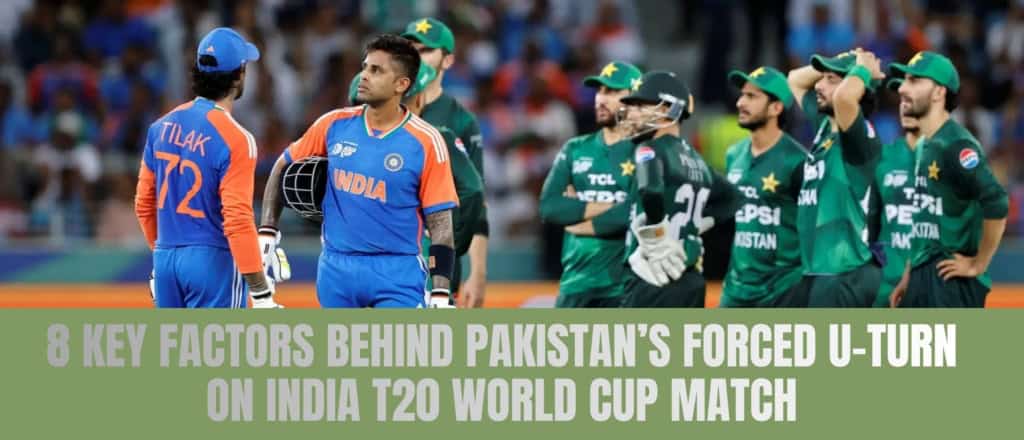
Pakistan India match controversy at the T20 World Cup ended after intense diplomatic, financial, and administrative pressure forced a reversal of Pakistan’s earlier boycott decision. What was publicly framed as a principled stand to protect the spirit of cricket ultimately became an unavoidable climbdown, driven by economic realities and institutional leverage within global cricket governance. Pak India Match Shifted From Political Signal to Negotiation Table
The Pak India match dispute began with a strong political declaration. Pakistan’s government confirmed participation in the T20 World Cup but announced that its team would not take the field against India. The move was positioned as a show of solidarity with Bangladesh, following developments related to tournament participation.
Once the decision became public, it triggered immediate concern across the cricketing ecosystem. The Pakistan Cricket Board echoed the government’s stance, insisting the move was based on principle rather than commercial interest. However, the announcement quickly exposed Pak to mounting external pressure.
ICC Financial Pressure Alters Pakistan India Match Stance
Refusing to play a scheduled World Cup fixture carries significant consequences, and the ICC made this clear early in the process. Officials warned that a boycott of the Pakistan India match could result in forfeited points, disciplinary action, and financial penalties, including the loss of ICC revenue distributions.
Beyond formal sanctions, the broader commercial impact was impossible to ignore. The Pakistan India match underpins the financial model of the T20 World Cup, with broadcasters and sponsors heavily invested in the fixture. A cancellation threatened to disrupt tournament revenues on a massive scale.
Broadcast and Revenue Concerns Intensify the Crisis
Broadcast partners raised alarm as the uncertainty surrounding the Pak India match grew. The fixture is widely regarded as the most valuable game in international cricket, driving viewership, advertising, and sponsorship commitments.
Estimates suggested that reversing the boycott would prevent revenue losses running into thousands of crores, underscoring the economic stakes involved. As financial implications became clearer, the tone of negotiations shifted noticeably.
Sri Lanka’s Intervention Adds Diplomatic Weight
Sri Lanka Cricket played a pivotal role in pushing for resolution. A formal appeal was sent to the Pakistan Cricket Board, highlighting shared history and mutual support during difficult periods. The message emphasized the broader consequences of cancelling the Pak India match, particularly for host nations and associate members reliant on shared revenues.
Sri Lanka also reminded Pakistan of past solidarity shown during periods when international cricket faced challenges, urging reciprocity in preserving the integrity of the global tournament. This appeal carried emotional and diplomatic significance.
Force Majeure Argument Triggers ICC Scrutiny
Following its boycott announcement, the Pak Cricket Board explored invoking the force majeure clause to justify non-participation. This move prompted immediate intervention from the ICC, which demanded legal clarity and justification under tournament regulations.
The ICC outlined strict thresholds required to activate such clauses and warned of contractual breaches and potential damages if the claim failed. This scrutiny further narrowed Pakistan’s options regarding the Pakistan India match.
Emergency Talks Lead to Behind-the-Scenes Bargaining
With pressure mounting, Pakistan agreed to emergency negotiations. Marathon discussions were held involving ICC officials, Pak Cricket Board leadership, and representatives from other affected boards. The talks focused on balancing political considerations with tournament obligations.
During these negotiations, Pakistan sought assurances related to broader stakeholder concerns, including relief measures connected to Bangladesh’s situation. Quiet alignments and compromises helped pave the way for a face-saving resolution.
Final Decision Reflects Cost of Holding Out
The eventual confirmation that Pakistan would play the Pak India match was presented publicly as a decision taken in the interest of cricket. Privately, it reflected the reality that continued resistance had become unsustainable.
Facing the prospect of financial losses, reputational damage, and isolation within the cricketing community, Pakistan recalibrated its position. The cost of maintaining the boycott had outweighed its symbolic value.
Why the Pakistan India Match Reversal Matters
The episode illustrates how economic and institutional forces shape decisions in modern international cricket. While political symbolism initially drove the narrative, financial accountability and governance frameworks ultimately determined the outcome.
The Pak India match reversal restores certainty to the T20 World Cup and reinforces the authority of global cricket institutions. It also serves as a reminder that marquee events rely on cooperation as much as competition.
Big Picture: Stability Returns to the T20 World Cup
With the Pak India match back on the schedule, focus returns to on-field action and tournament momentum. Stakeholders can now move forward without the distraction of unresolved disputes, ensuring the competition unfolds as planned.
The U-turn may have been framed as a principled choice, but the reality was shaped by pressure, negotiation, and financial reality. In the end, cricket’s biggest rivalry will proceed, preserving the integrity and commercial foundation of the T20 World Cup.


Responses