

T20 World Cup 2026: 4 Major Twists In India Semi-Final Venue

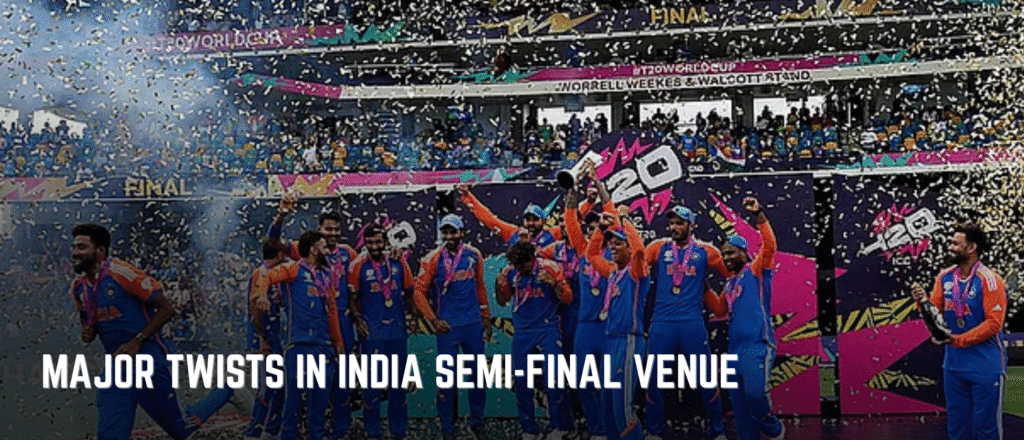
T20 World Cup 2026 could witness four major twists involving India’s semi-final venue, as scheduling dynamics and the India vs Pakistan scenario may force a dramatic change from Mumbai to Colombo. With knockout qualification at stake, the tournament’s hybrid model agreement has added another layer of complexity to India’s path. The T20 World Cup 2026 schedule initially indicates that if India qualify for the semi-finals, they will play the second semi-final at the iconic Wankhede Stadium in Mumbai. However, that arrangement is not guaranteed and depends heavily on Pakistan’s progress in the competition.
T20 World Cup 2026: Why India May Not Play In Mumbai
The T20 World Cup 2026 format includes a condition tied specifically to an India vs Pakistan clash. If both teams qualify for the semi-finals and are set to face each other, the match will not take place in India. Instead, it will be moved to the R Premadasa Stadium in Colombo.
This potential shift stems from the hybrid model agreement between the two cricket boards. Under this arrangement, all India vs Pakistan matches in ICC tournaments are to be held at neutral venues until 2027. As a result, the T20 World Cup 2026 semi-final venue would change if the two rivals meet in the knockout stage.
India vs Pakistan Scenario Explained
The India vs Pakistan semi-final scenario in the T20 World Cup 2026 depends on Super 8 standings. If India finish first in their Super 8 group and Pakistan finish second — or vice versa — the two teams would clash in the semi-finals.
In such a case, India would not play the scheduled second semi-final in Mumbai on March 5. Instead, they would feature in the first semi-final in Colombo on March 4.
This adjustment would not only alter venue logistics but also require India to travel internationally during a crucial phase of the T20 World Cup 2026.
Hybrid Model Agreement Impact
The hybrid model agreement remains central to the T20 World Cup 2026 scheduling debate. Due to political and diplomatic considerations, India vs Pakistan fixtures are mandated to take place at neutral venues.
Therefore, even though India are co-hosts of the tournament, the regulations override home advantage in the event of a direct clash with Pakistan. The ICC had previously clarified that if India face any opponent other than Pakistan in the semi-finals, Mumbai will host the match as planned.
This provision ensures compliance with the agreement while maintaining flexibility in the T20 World Cup 2026 calendar.
Holi Factor And Travel Challenges
An additional twist in the T20 World Cup 2026 semi-final scheduling involves the festival of Holi. If India are required to travel to Colombo for a semi-final against Pakistan, they would be playing on March 4 — coinciding with Holi celebrations in India.
The shift also means logistical adjustments, including travel arrangements, accommodation changes, and acclimatization to a different venue. While professional teams are accustomed to such movements, knockout-stage preparation time is crucial in a tournament as intense as the T20 World Cup 2026.
Venue Changes For Other Teams
The T20 World Cup 2026 venue changes are not limited to India alone. If Pakistan qualify for the semi-finals, the originally planned first semi-final venue in Kolkata would also be moved to Colombo.
This cascading effect highlights how the India vs Pakistan clause influences the broader tournament schedule. Even co-host Sri Lanka could face travel requirements, as they might need to travel to India for a potential semi-final despite being joint hosts.
Such adjustments underline the logistical complexity embedded within the T20 World Cup 2026 framework.
Strategic Implications For India
From a strategic standpoint, venue certainty plays an important role in preparation. Knowing pitch conditions, crowd dynamics, and travel schedules allows teams to fine-tune plans.
In the T20 World Cup 2026, India’s management must prepare for both possibilities — playing in Mumbai or traveling to Colombo. Flexibility and adaptability become essential traits in navigating knockout stages.
The India vs Pakistan narrative also adds psychological intensity. A semi-final between the two rivals would command global attention and immense pressure, regardless of venue.
ICC’s Position On Semi-Final Allocation
The ICC clarified in its release that Mumbai will host Semi-Final 2 involving India if they face any team other than Pakistan. This conditional allocation was built into the T20 World Cup 2026 schedule from the outset.
By pre-determining neutral venue arrangements, the governing body aimed to avoid last-minute uncertainty. Nevertheless, the situation remains dependent on Super 8 outcomes.
As standings evolve, the focus remains on whether the India vs Pakistan matchup materializes in the semi-finals.
What It Means For Fans And Broadcasters
The T20 World Cup 2026 scheduling twist carries implications beyond team logistics. Broadcasters, sponsors, and fans must also adapt to potential changes.
An India vs Pakistan semi-final in Colombo would attract massive global viewership. However, shifting a high-profile knockout fixture from Mumbai to Colombo alters ticketing, security planning, and local economic impact.
Despite these challenges, the hybrid model ensures that geopolitical sensitivities are managed within the tournament structure.
A Semi-Final With Multiple Possibilities
The T20 World Cup 2026 semi-final scenario encapsulates the tournament’s dynamic nature. While India are scheduled to play in Mumbai, the India vs Pakistan equation could redirect them to Colombo under the hybrid agreement.
Four major twists Super 8 standings, neutral venue policy, travel logistics, and the Holi date — combine to create uncertainty around India’s knockout path.
Ultimately, results in the Super 8 will determine whether India remain in Mumbai or board a flight to Colombo. Until then, the T20 World Cup 2026 continues to deliver intrigue both on and off the field.

Responses