

T20 World Cup Row: 6 Shocking Bangladesh Claims

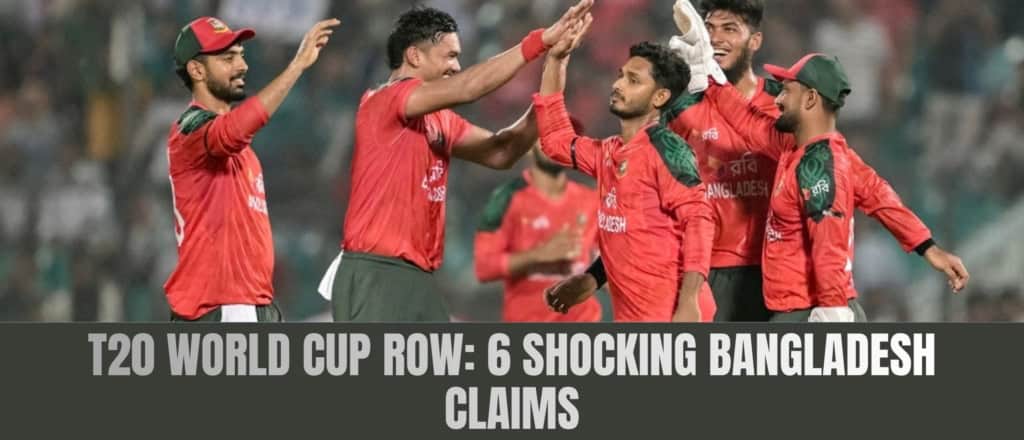
T20 World Cup row has erupted after 6 shocking Bangladesh claims surfaced regarding their withdrawal and the alleged role of Pakistan in influencing that decision. The controversy surrounding the T20 World Cup 2026, co-hosted by India and Sri Lanka, has exposed deep cracks in Asian cricket diplomacy and placed the Bangladesh Cricket Board under intense scrutiny.
The T20 World Cup dispute began when Bangladesh refused to travel to India citing security concerns, a move that ultimately led to their removal from the tournament. The Bangladesh Cricket Board decision triggered widespread debate, especially after former Asian Cricket Council official Syed Ashraful Haque suggested that Bangladesh may have been misled during the crisis.
T20 World Cup Crisis: How the Bangladesh Cricket Board Decision Unfolded
The T20 WC controversy took shape when Bangladesh declined to tour India for the marquee event. According to reports, the Bangladesh Cricket Board cited security issues as the primary reason for their stance. However, critics argue that the decision was premature and poorly calculated.
The Bangladesh Cricket Board’s refusal resulted in their exclusion from the T20 World Cup 2026. This drastic outcome shocked fans in one of the most cricket-passionate nations in Asia. The fallout not only deprived Bangladesh players of global exposure but also left supporters questioning the leadership’s judgment.
Syed Ashraful Haque’s Explosive Pakistan Allegation
Former Asian Cricket Council CEO Syed Ashraful Haque added fuel to the T20 WC row by hinting that Pakistan Cricket Board chairman Mohsin Naqvi may have influenced Bangladesh’s stance. Haque claimed that Bangladesh Cricket Board chairman Aminul Islam may have been persuaded to align with Pakistan’s position.
According to Haque, the Bangladesh Cricket Board leadership lacked experience in international cricket diplomacy. He suggested that Aminul Islam “walked into a trap,” prioritizing political considerations over players’ interests. The T20 WC dispute, therefore, may have stemmed from diplomatic miscalculations rather than genuine security threats.
Pakistan’s Role in the T20 World Cup Dispute
The T20 WC narrative became more complex when Pakistan reportedly expressed solidarity with Bangladesh after their removal. Pakistan initiated what some described as a “boycott drama” over their own match against India, claiming to stand by Bangladesh.
This sequence of events deepened the crisis for the Bangladesh Cricket Board. Haque’s remarks imply that Pakistan’s involvement may have complicated an already delicate situation. In the high-stakes environment of the T20 World Cup, such alliances can carry significant consequences for all parties involved.
The IPL Factor and Mustafizur Rahman Issue
Another key dimension of the T20 World Cup controversy was linked to Mustafizur Rahman’s participation in the IPL. Haque criticized the Bangladesh Cricket Board for reacting strongly after Mustafizur was not permitted to play in the Indian Premier League during the same period.
He argued that the Bangladesh Cricket Board had ample time to negotiate with the BCCI and the Indian government rather than escalate tensions. In his view, the ICC had already committed to providing security arrangements for the T20 World Cup, and additional assurances could have been sought diplomatically.
Impact on Bangladesh Players and Fans
The T20 World Cup exclusion has had far-reaching implications for Bangladesh players. Cricketers such as Liton Das, Mustafizur Rahman, and Najmul Hossain Shanto are in the prime of their careers. Missing a global event like the T20 World Cup represents a significant setback for both individual ambitions and national pride.
The Bangladesh Cricket Board’s decision also disappointed millions of fans. Bangladesh is widely regarded as one of the most cricket-obsessed nations after India. The absence of their team from the T20 World Cup has been described by critics as an injustice to supporters who eagerly anticipate global tournaments.
Cricket Diplomacy and Asian Power Dynamics
The T20 World Cup row has highlighted the fragile balance of power in Asian cricket. India, Pakistan, Bangladesh, Sri Lanka, and Afghanistan collectively command massive audiences and commercial influence. Yet unity remains elusive.
The Bangladesh Cricket Board’s predicament underscores the importance of diplomatic skill in international cricket governance. In tournaments like the T20 World Cup, political undertones can quickly influence sporting decisions. Haque’s criticism reflects a belief that better negotiation could have prevented Bangladesh’s removal.
ICC’s Role in the T20 World Cup Situation
The ICC’s involvement in organizing the T20 World Cup added another layer to the controversy. As the global governing body, the ICC had assured participating teams of adequate security arrangements. Haque emphasized that concerns could have been addressed through official channels rather than withdrawal.
The Bangladesh Cricket Board’s approach has been widely debated, with some defending caution while others argue that the cost of missing the T20 World Cup outweighed potential risks.
Long-Term Consequences for Bangladesh Cricket
The T20 World Cup exclusion may have lasting effects on Bangladesh cricket’s global standing. Sponsorship opportunities, player morale, and international relationships could all be impacted. The Bangladesh Cricket Board now faces the challenge of rebuilding trust with fans and restoring confidence in its leadership.
The controversy also serves as a cautionary tale for other cricket boards navigating geopolitical tensions. In an era where tournaments like the T20 World Cup generate enormous revenue and visibility, strategic missteps can carry heavy consequences.
Lessons from the T20 World Cup Row
The T20 World Cup dispute involving the Bangladesh Cricket Board is a complex blend of sport, politics, and diplomacy. Syed Ashraful Haque’s claims have intensified scrutiny, suggesting that internal misjudgments and external influence may have shaped the outcome.
As the cricketing world reflects on the episode, one message stands out: participation in global tournaments like the T20 World Cup demands careful negotiation, clear communication, and unwavering focus on players’ interests. For Bangladesh cricket, the path forward will require learning from this controversy and ensuring that future decisions protect both the team’s competitive ambitions and the passion of its fans.



Responses